
Published by ANZ Global Group LLC FZ | anzglobalgroup.com
Transport infrastructure is the single largest application segment driving GFRP rebar adoption globally. Highways, bridges, and buildings together account for the fastest-growing end-use category in the GFRP rebar market — driven by a straightforward reality: the structures that carry the most traffic, in the most exposed environments, are also the ones where steel reinforcement fails earliest and costs most to maintain.
The global GFRP rebar market is projected to reach USD 1.68 billion by 2035, growing at 12.06% annually. Transport infrastructure is at the centre of that growth — because bridges, highway pavements, tunnels, and elevated road structures represent exactly the combination of structural loading, environmental exposure, and long design life requirements where GFRP’s properties produce the clearest advantage.
For engineers, contractors, and procurement teams working on transport infrastructure — in GCC, Africa, or any market where design life and maintenance cost matter — this post covers where GFRP makes the strongest case and why.
The Core Problem: Why Transport Infrastructure Deteriorates
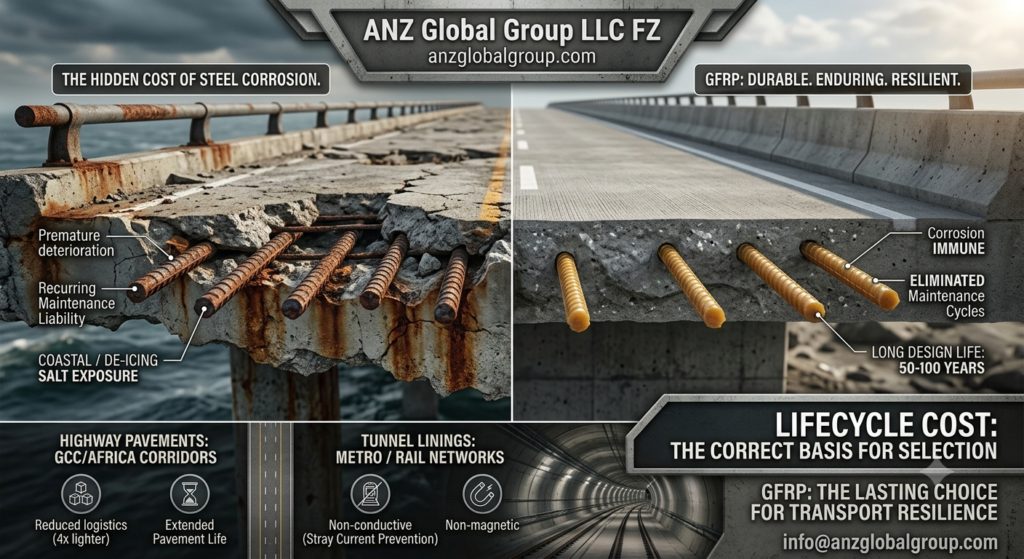
The primary cause of premature deterioration in reinforced concrete transport infrastructure is steel reinforcement corrosion. The mechanism is consistent across climates and geographies — it is the material, not just the environment, that creates the vulnerability.
- Bridge decks and approach slabs are among the most corrosion-exposed concrete elements in transport infrastructure. In coastal regions, marine air carries chlorides that penetrate concrete cover and attack embedded steel. In colder climates, de-icing salts applied to road surfaces create concentrated chloride exposure on bridge decks. In tropical and humid environments, sustained moisture penetration through concrete cracks accelerates carbonation and brings moisture into contact with steel reinforcement.
- The deterioration pattern: Steel corrodes, expands, cracks the surrounding concrete, allows faster moisture and chloride penetration, and accelerates further deterioration. Cracking leads to spalling. Spalling exposes corroded reinforcement. Structural capacity is progressively reduced. Maintenance intervention — concrete patching, steel treatment, deck resurfacing — becomes a recurring cost that grows with every cycle.
- Highway pavements and rigid road surfaces experience similar deterioration in environments where moisture ingress, sub-base movement, or chemical exposure reach embedded reinforcement. Pavement cracking in corrosive environments is frequently corrosion-driven at the reinforcement level, not purely a surface or loading issue.
- Tunnels and underground structures face some of the most aggressive reinforcement environments of any transport infrastructure type. Underground tunnels accumulate groundwater and condensation. In urban metro environments, salt contamination from de-icing operations permeates through drainage systems. In rock tunnels, sulphate-bearing groundwater creates aggressive chemical attack. Tunnel linings reinforced with steel require inspection and maintenance access that is both expensive and disruptive to operations.
Why GFRP Changes the Performance Equation
GFRP rebar eliminates the primary failure mechanism of transport infrastructure deterioration. Because it does not corrode, it does not initiate the cracking and spalling cycle that drives steel-reinforced structure maintenance costs.
- For bridge decks and approach slabs: GFRP-reinforced concrete decks maintain structural integrity across the full design life without the corrosion-driven intervention cycles that steel decks accumulate. In coastal and marine-adjacent bridge environments — particularly relevant across the GCC coastline and Africa’s coastal highway networks — this is not a marginal improvement. It is the elimination of a recurring maintenance liability.
- For highway pavements: GFRP-reinforced rigid pavements in corrosive environments deliver extended pavement life without corrosion-driven cracking. The weight advantage — GFRP is approximately four times lighter than steel — also reduces transportation and handling costs for large-volume reinforcement requirements, which matters on extended highway programmes.
- For tunnels and underground infrastructure: GFRP’s combination of corrosion immunity, electrical non-conductivity, and non-magnetic properties makes it particularly well suited. In electrified metro and rail tunnel environments, GFRP’s non-conductivity prevents stray current corrosion — a failure mechanism specific to electrified rail infrastructure that steel reinforcement is particularly vulnerable to. In underground structures generally, GFRP eliminates the need for corrosion inspection access that steel-reinforced tunnel linings require.
- For railway sleepers and track infrastructure: GFRP’s non-conductivity and non-magnetic properties are direct specification advantages in electrified rail environments where electromagnetic compatibility is a design requirement.
- For crash barriers and road furniture: GFRP’s lightweight and corrosion resistance reduce both initial installation cost and long-term maintenance requirements for infrastructure elements that experience continuous environmental exposure.
The Lifecycle Cost Case for Transport Infrastructure
Transport infrastructure is built to last — national highways, major bridges, metro tunnels, and rail infrastructure are designed for 50, 75, or 100-year service lives. The reinforcement material decision at the design stage determines whether that service life is actually achieved, or whether the structure requires major intervention at the 20 or 30-year mark.
Steel-reinforced bridge decks in aggressive environments — coastal, de-icing salt, or high-humidity conditions — frequently require major rehabilitation within 25 to 40 years of construction. Rehabilitation costs for a bridge deck in advanced corrosion deterioration run from 30 to 70% of original construction cost. For a national highway programme with hundreds of structures, that liability accumulates to significant levels.
GFRP-reinforced structures in equivalent environments do not accumulate that liability. The higher upfront material cost is real — and should be presented honestly in any specification discussion. But over a 50 to 100-year infrastructure service life, the lifecycle cost comparison consistently favours GFRP in environments where corrosion is an active factor.
For transport ministries, road authorities, and infrastructure developers making long-term asset investment decisions, lifecycle cost is increasingly the correct basis for reinforcement material selection — not the per-tonne unit price comparison.
Application Areas in GCC and African Transport Infrastructure
- GCC highway and bridge infrastructure. The GCC’s coastal highway networks — running along the Arabian Gulf, Red Sea, and Gulf of Oman — combine marine air exposure with extreme thermal cycling. Bridges and highway structures in these corridors are in environments where GFRP’s lifecycle cost advantage is most pronounced. Saudi Arabia’s road and transport infrastructure programme, the UAE’s ongoing connectivity investments, and Qatar’s post-World Cup infrastructure maintenance needs all create relevant procurement contexts.
- African highway and bridge programmes. Major highway programmes across Nigeria, Kenya, Ethiopia, Tanzania, South Africa, and Ghana are creating sustained demand for reinforcement materials. Coastal highway infrastructure, river crossing bridges in high-humidity environments, and urban elevated road structures in rapidly growing coastal cities are all application contexts where GFRP’s durability advantage is directly relevant.
- Metro and urban rail tunnels. Urban metro programmes in GCC cities — Riyadh Metro, Doha Metro Phase 2, Abu Dhabi’s planned metro — and in African cities — Cairo, Lagos, Nairobi — represent significant tunnel infrastructure demand where GFRP’s non-conductivity and corrosion immunity are directly applicable.
Product Specifications for Transport Applications
GFRP rebar for transport infrastructure applications is available in compliance with:
- ASTM D7957 / D7959M — primary reference for highway and bridge applications under ACI design guides
- IS 18256:2023 — referenced under India’s Ministry of Road Transport and Highways for FRP reinforcement in bridge construction pilot projects, applicable for Indian-linked and development-financed transport projects
- IRC 137-2022 — the Indian Roads Congress guideline specifically for GFRP in highway infrastructure
- AS 5204:2023 — relevant for transport projects with Australian engineering involvement
Structural design under ACI 440.1R-15, ACI 440.11-2022, and FIB Bulletin 40 provides the engineering framework for GFRP specification in transport infrastructure applications.
Product is available from 3mm to 25mm diameter in straight bar form and 3mm to 12mm in coil options, with custom bent shapes available for specific structural applications.
Working With ANZ Global Group
ANZ Global Group’s Advanced Reinforcement Solutions vertical sources GFRP rebar for infrastructure developers, transport contractors, and project teams across GCC, Africa, and international markets through quality-oriented manufacturer partnerships.
Supply coordination includes product specification review, documentation management, logistics coordination, and delivery follow-up — the same execution-focused sourcing model applied across ANZ’s full industrial supply portfolio.
- Email: info@anzglobalgroup.com
- UAE: +971 50794 4739
- India: +91 86799 58783
- USA: +1-301-915-0995
- Website: www.anzglobalgroup.com
Supplying Trust. Delivering Value.