Published by ANZ Global Group LLC FZ | anzglobalgroup.com
Line pipe is the backbone of oil and gas transportation infrastructure. From gathering systems and trunk lines to process plant piping and subsea flowlines, the structural integrity of the pipe — and the procurement discipline behind it — determines the safety and reliability of systems that often operate for decades under continuous pressure.
The global line pipe market is valued at approximately USD 15.76 billion in 2025, growing at around 4.9% annually through to 2031 — driven by expanding pipeline networks across the Middle East, Africa, and Asia, rising natural gas demand, and ongoing replacement of aging pipeline infrastructure. In the MENA region specifically, the API steel pipe market is valued at USD 7.5 billion in 2025 and growing at 6% annually, with API 5L dominating at 53.7% market share — directly reflecting active pipeline development across GCC and North African producing countries.
For procurement teams sourcing line pipe for these markets, the challenge is consistent: getting the right grade, the right manufacturing process, and the right documentation to the right location on the right schedule. This guide covers what that actually requires.
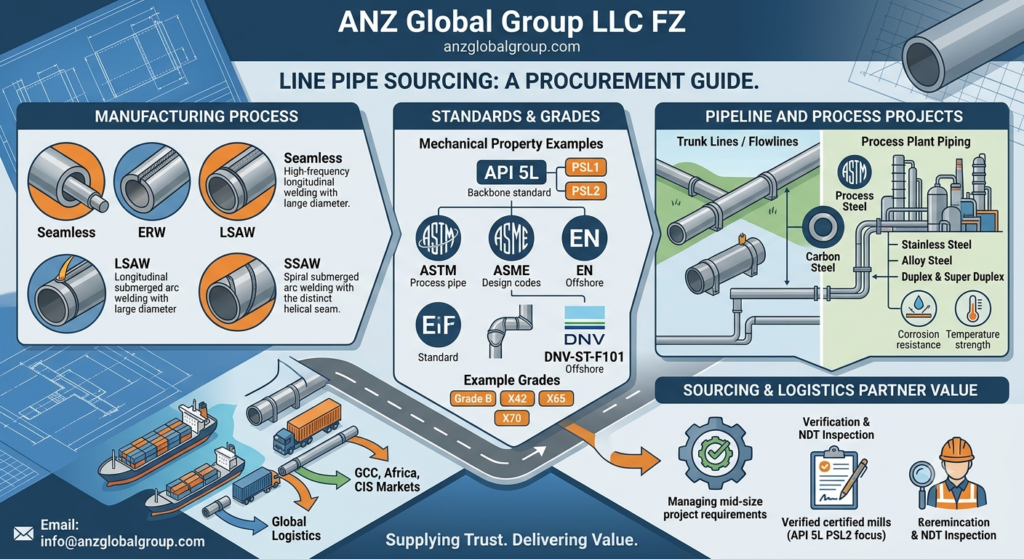
1. Manufacturing Process: Seamless, ERW, LSAW, or SSAW
The first procurement decision for line pipe is the manufacturing process — and it is not interchangeable between applications.
- Seamless pipe is produced by piercing a solid billet through a mandrel, producing a pipe with no longitudinal weld seam. It is the preferred choice for high-pressure, high-temperature, and sour service applications — subsea pipelines, HPHT gathering systems, and process plant critical service lines — where the absence of a weld seam reduces the risk of seam-related defects under demanding service conditions. Seamless pipe is available in smaller diameters and is generally the higher-cost option.
- ERW (Electric Resistance Welded) pipe is formed by rolling steel strip into a cylindrical shape and welding the longitudinal seam using electric resistance heat — no filler material. Modern high-frequency ERW pipe produced by qualified mills to API 5L PSL2 is widely used in onshore gathering and transmission pipelines. The weld seam is a controlled variable, and the key procurement consideration is confirming that the mill’s ERW process and weld seam inspection regime meets the applicable standard and the project’s NDT requirements.
- LSAW (Longitudinal Submerged Arc Welded) pipe is produced from plate that is formed into a cylindrical shape and welded with a submerged arc process — producing a pipe with one or two longitudinal seams depending on diameter. LSAW is the standard choice for large-diameter, thick-wall transmission pipelines — major trunk lines, export pipelines, and offshore risers in larger diameters. It offers good dimensional control and the SAW process produces reliable, inspectable weld seams in the diameters where seamless is not available.
- SSAW (Spiral Submerged Arc Welded) pipe is produced by spirally forming strip steel and welding the helical seam with a submerged arc process. SSAW is used in lower-pressure applications — water transmission, piling, structural applications — and is generally not specified for high-pressure oil and gas service where LSAW or seamless are preferred. The spiral seam creates directional variation in residual stress and weld orientation that is a limitation in demanding service conditions.
The specification of manufacturing process should be driven by service conditions, diameter, and wall thickness requirements — not by what is most readily available or cheapest to source. Substituting ERW for seamless in sour service, or SSAW for LSAW in a high-pressure transmission line, because the preferred type is less available or higher in price, is a procurement decision with safety and liability implications.
2. API 5L Grade Selection and PSL Level
API 5L is the governing standard for line pipe used in pipeline transportation systems for the petroleum and natural gas industries. Grade selection and PSL level are two distinct decisions that are often conflated — and getting both right matters.
Grade determines the pipe’s mechanical properties — yield strength, tensile strength, and elongation. The commonly specified grades in international pipeline projects are:
- Grade B — minimum yield strength 245 MPa; the baseline grade for lower-pressure applications
- X42, X52, X60 — progressively higher yield strength grades used in standard transmission pipeline service
- X65, X70 — high-strength grades used in large-diameter, high-pressure trunk lines and offshore pipelines where wall thickness reduction is a design objective
- X80 — high-strength grade for major long-distance transmission lines; requires careful attention to weldability and requires qualified welding procedures
PSL (Product Specification Level) determines the standard of testing, inspection, and documentation applied to the pipe:
- PSL1 — the baseline level; covers standard chemical, mechanical, and dimensional requirements with standard testing frequencies
- PSL2 — enhanced requirements covering chemistry, mechanical testing, fracture toughness, weld inspection, and hydrostatic testing at higher frequencies; mandatory for sour service and offshore applications in most project specifications
- PSL3 — additional requirements beyond PSL2 for the most demanding applications
A common procurement error is specifying the correct grade but the wrong PSL — ordering PSL1 where the project or operator requires PSL2, or vice versa. The PSL level affects both the mill’s production and testing obligations and the documentation package that accompanies the pipe. Confirming PSL requirements at the specification stage, not after the order is placed, prevents this avoidable problem.
3. Material Selection Beyond Carbon Steel
While carbon steel is the standard material for most line pipe applications, process plant piping and specialty service conditions require material selection beyond API 5L grades.
- Stainless steel line pipe is specified for corrosive process service — produced to ASTM A312 (seamless and welded austenitic stainless) or equivalent, in grades such as 316L for general corrosive service and duplex or super duplex grades for high-chloride or sour environments.
- Alloy steel is used for high-temperature service — typically ASTM A335 seamless ferritic alloy steel pipe for elevated temperature pressure service in refineries and process plants.
- Duplex and super duplex stainless steel — UNS S31803/S32205 and UNS S32750/S32760 respectively — are specified for offshore flowlines, subsea pipelines, and process plant applications involving high chloride content, elevated temperatures, and sour service conditions where carbon steel, even with corrosion allowance, would not provide adequate service life.
Material selection for process plant and specialty pipeline service should be confirmed with the project’s process engineer or materials engineer — not determined by procurement on the basis of availability or cost alone. The consequences of incorrect material selection in process plant service are significantly more serious than a dimensional or documentation error.
4. Standards Beyond API 5L
Not all line pipe projects are governed by API 5L alone. International pipeline and process plant projects may reference a range of standards depending on the project’s engineering origin and the client’s requirements:
- ASTM A53 / A106 — for standard and high-temperature carbon steel pipe in process plant service
- ASME B31.4 / B31.8 — design codes for liquid and gas pipeline systems respectively, which determine the applicable pipe specification within the code
- DNV-ST-F101 — the Det Norske Veritas standard for submarine pipeline systems, widely used on offshore pipeline projects
- EN 10208 — European standard for steel pipes for combustible fluids, applicable on projects with European engineering involvement
- ISO 3183 — the ISO equivalent of API 5L, referenced on international projects where ISO standards are preferred
Confirming the applicable standard at the start of the procurement process — not assuming API 5L universally applies — is part of the technical review that effective sourcing requires.
5. Where Trading Companies Like ANZ Add Real Value
Line pipe sourcing is a category where the gap between a quotation and a delivered, document-compliant consignment is wide — and where the role of a specialist sourcing partner is frequently misunderstood.
Large pipe mills — Jindal, Nippon Steel, ArcelorMittal, Tenaris, and others — produce at scale and sell through established commercial channels. For major national pipeline projects with single-source requirements in the hundreds of thousands of tonnes, dealing directly with a major mill is appropriate and efficient.
For mid-size project requirements — a pipeline spool package for a GCC process plant, a gathering system expansion in West Africa, a replacement pipe package for an aging onshore system — the procurement reality is different. Major mills have minimum order quantities and commercial priorities that do not always align with mid-size project timelines or quantities. Lead times from major mills in periods of high utilisation can stretch beyond project schedules. And the documentation, inspection, and logistics coordination required to get the right pipe to an African or GCC project site on schedule requires hands-on management that a mill’s commercial team is not structured to provide.
This is where a specialist sourcing partner like ANZ Global Group creates genuine value — not by competing with major mills on volume, but by navigating the sourcing landscape for mid-size requirements where direct mill access is constrained, coordinating inspection and documentation as a standard service rather than an afterthought, and managing the logistics complexity of getting certified, document-compliant pipe to challenging market destinations on project timelines.
ANZ’s sourcing network spans certified mills across Asia and the Middle East — mills producing to API 5L PSL1 and PSL2 across seamless, ERW, and LSAW manufacturing processes — with third-party inspection coordination through internationally recognised agencies and full documentation support as standard.
For projects where the requirement is too specific for stock and too small for a major mill’s priority queue, a sourcing partner who manages the full cycle from mill selection to delivery is not a convenience. It is the difference between the pipe arriving on time and the project waiting.
Working With ANZ Global Group
ANZ Global Group LLC FZ sources line pipe and piping materials for pipeline, process, and infrastructure projects across GCC, Africa, CIS, and international markets — in carbon steel, stainless steel, alloy steel, duplex and super duplex grades, to API 5L, ASTM, ASME, EN, and DNV standards.
- Email: info@anzglobalgroup.com
- UAE: +971 50794 4739
- India: +91 86799 58783
- USA: +1-301-915-0995
- Website: www.anzglobalgroup.com
Supplying Trust. Delivering Value.