
Published by ANZ Global Group LLC FZ | anzglobalgroup.com
Most discussions about GFRP rebar centre on corrosion resistance — and rightly so, given the scale of the problem it solves in coastal, marine, and chemically aggressive environments. But there is a category of applications where the case for GFRP rests on an entirely different property set: its electrical non-conductivity and complete non-magnetic character.
In these environments, the question is not whether steel will corrode. The question is whether steel’s electromagnetic signature will interfere with the facility’s core function — and in several critical infrastructure categories, the answer is definitively yes.
Hospitals with MRI suites, airports with navigation and radar systems, power plants and transformer substations, data centres, and compass calibration facilities all share a common design challenge: they require structural reinforcement that is electromagnetically neutral. Steel rebar — inherently ferromagnetic and electrically conductive — cannot meet that requirement. GFRP rebar can, and in many of these applications it is not merely preferred. It is the only structurally sound option available.
Understanding the Electromagnetic Properties That Make GFRP Unique
GFRP rebar is manufactured from glass fibres set in a polymer resin matrix. Glass fibres contain no free electrons and have no magnetic domains — the two physical mechanisms through which steel creates electromagnetic interference. The result is a reinforcement material that is:
- Electrically non-conductive — with electrical resistivity exceeding 10¹² Ω·cm, GFRP does not conduct electricity and does not create unintended conductive pathways through concrete structures. This is relevant for facilities where stray electrical currents, earthing requirements, or high-voltage proximity are design factors.
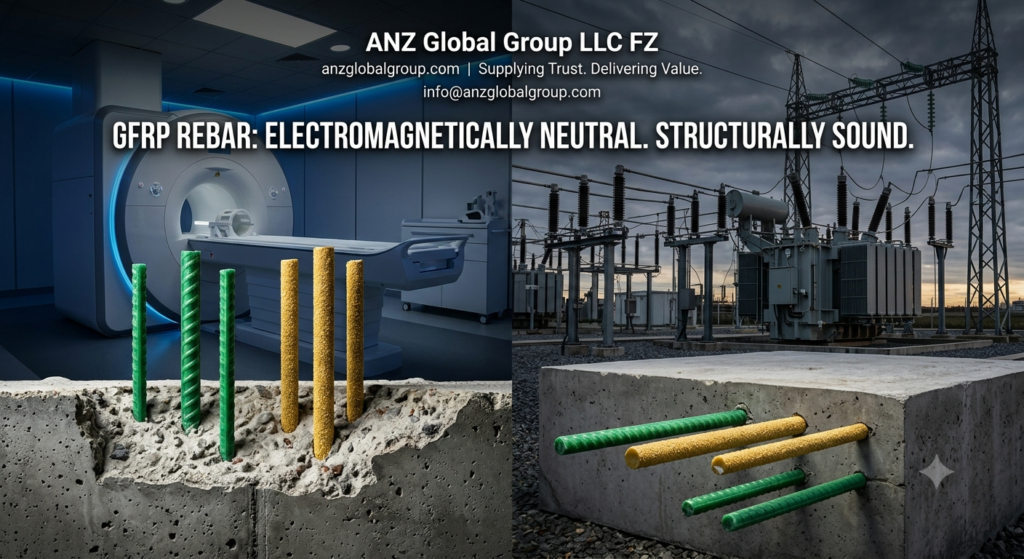
- Completely non-magnetic — GFRP does not distort magnetic fields, does not interact with electromagnetic systems, and produces no ferromagnetic signature detectable by sensitive instruments. This is the critical property for MRI facilities, navigation systems, and precision measurement environments.
These are not marginal improvements over steel. They are fundamental material differences that make GFRP the specification-mandated choice across several high-value, technically demanding application categories.
1. Hospitals and MRI Facilities
MRI (Magnetic Resonance Imaging) machines operate by generating extremely powerful magnetic fields — typically 1.5 Tesla to 3 Tesla in clinical systems, and higher in research applications. The integrity of that magnetic field depends on the electromagnetic environment of the room. Steel reinforcement in the walls, floor, and ceiling of an MRI suite creates ferromagnetic distortion that degrades image quality, affects machine calibration, and in extreme cases can create safety hazards through projectile risk from steel elements in the magnetic field zone.
MRI suite construction to manufacturer site planning requirements — whether from Siemens Healthineers, GE Healthcare, Philips, or other major manufacturers — mandates non-magnetic structural reinforcement within the RF shielding zone. NABH-accredited hospitals in India specifying MRI facilities are expected to comply with these site planning requirements as a condition of equipment commissioning. The same applies across GCC healthcare facilities operating to JCI or equivalent accreditation standards.
GFRP rebar, being completely non-magnetic, enables the construction of structurally sound MRI suites without electromagnetic compromise. The concrete structure itself provides the required shielding continuity without introducing the ferromagnetic distortion that steel reinforcement would create.
Beyond MRI suites, GFRP finds application across other hospital areas where electromagnetic neutrality is a design requirement — radiology departments, cardiac catheterisation labs, research imaging facilities, and areas housing sensitive diagnostic equipment where stray electromagnetic fields affect measurement accuracy.
The procurement implication: Hospital construction projects specifying MRI facilities should confirm GFRP rebar as the structural reinforcement for the MRI suite and adjacent shielding zones at the design stage — not as a value engineering alternative, but as a specification requirement driven by the equipment manufacturer’s site planning documentation.
2. Airports and Navigation Infrastructure
Airports contain multiple systems sensitive to electromagnetic interference — ILS (Instrument Landing System) localiser and glide path antennas, VOR (VHF Omnidirectional Range) navigation beacons, compass calibration pads, and surface movement radar installations. Steel reinforcement in concrete structures near these systems can distort the electromagnetic signatures they emit or receive, degrading navigation accuracy and creating safety-critical errors in aircraft guidance.
Compass calibration pads are the most directly relevant airport application for GFRP rebar. These are dedicated concrete pads where aircraft compass systems are calibrated before flight — a safety-critical procedure that requires a magnetically neutral surface environment. Any ferromagnetic material in the concrete pad — including steel reinforcement — introduces magnetic anomalies that affect calibration accuracy. GFRP reinforcement is the standard specification for compass calibration pads precisely because it provides the structural integrity required without the magnetic signature that would compromise the calibration process.
Runway and apron pavements near navigation antenna installations may also specify GFRP or other non-magnetic reinforcement where proximity to ILS or VOR systems makes steel reinforcement electromagnetically problematic.
Toll plazas and traffic management infrastructure — though not airport-specific — share the same electromagnetic sensitivity where electronic toll collection systems, vehicle detection sensors, and traffic monitoring equipment require non-conductive, non-magnetic reinforcement in the sensor zone concrete.
3. Power Plants and Transformer Substations
Power generation and high-voltage transmission infrastructure creates its own electromagnetic environment — one where steel reinforcement in adjacent concrete structures can interact with the electromagnetic fields generated by transformers, switchgear, and high-voltage busbars.
Transformer foundations are a primary application. Large power transformers generate significant magnetic flux during operation. Steel reinforcement in the transformer foundation can experience induced currents from transformer magnetic fields — creating localized heating, accelerated corrosion, and in some configurations, structural fatigue. GFRP reinforcement eliminates the induction pathway entirely.
Electrical substations house high-voltage equipment where electrical safety and electromagnetic compatibility are design requirements across the entire facility. Concrete structures housing switchgear, busbars, and control systems benefit from non-conductive reinforcement that does not create unintended earthing pathways or electromagnetic coupling between structural elements and electrical equipment.
Nuclear power plants represent the most demanding version of this requirement — where both electromagnetic compatibility and radiation resistance are design factors. GFRP’s non-conductivity and non-magnetic properties, combined with its resistance to radiation degradation in the doses experienced in secondary containment structures, make it a specified material in nuclear construction in several countries.
Renewable energy infrastructure — solar farm foundations, wind turbine bases, and battery storage facility structures — increasingly specifies GFRP where electrical isolation between the structural concrete and the energy equipment is a design or safety requirement.
4. Data Centres and Sensitive Electronic Facilities
Data centres house servers, networking equipment, and storage infrastructure that is sensitive to both electromagnetic interference and static discharge. While the concrete structure of a data centre does not typically sit within the electromagnetic field of the IT equipment in the way an MRI suite does, the non-conductive and non-magnetic properties of GFRP provide a belt-and-braces electromagnetic compatibility that increasingly sophisticated facilities are specifying.
High-frequency trading facilities, quantum computing research centres, and defence electronics installations represent the most demanding end of this spectrum — environments where any ferromagnetic or conductive element in the building structure is a potential source of measurement error or signal interference.
Where Trading Companies Like ANZ Play a Critical Role
Specialized applications — MRI suites, airport infrastructure, power plant foundations — are typically procured through highly specific project supply chains where the contractor or developer may be encountering GFRP for the first time in their project history.
This creates a specific sourcing challenge. The engineer specifies GFRP. The contractor has no established supplier relationship for it. The procurement team does not know which manufacturers produce to the required standard, what documentation is expected, or how to coordinate supply within the project timeline.
This is precisely the space where a sourcing partner like ANZ Global Group adds value that neither a major steel rebar distributor nor a direct manufacturer relationship provides.
A large steel rebar supplier has no GFRP capability and no incentive to develop one for a single project requirement. A GFRP manufacturer based in Asia has no established logistics relationship with a GCC hospital contractor or an African airport developer, and no experience navigating the documentation requirements of those markets.
ANZ sits between these two gaps — with manufacturer relationships across qualified GFRP producers, the sourcing expertise to match the project’s specification and standard requirements to the right supply source, and the logistics and documentation coordination capability to manage delivery to GCC, African, and international project destinations.
For a contractor building a hospital MRI suite in Riyadh, a power plant transformer foundation in Lagos, or an airport compass calibration pad in Nairobi — who has a GFRP specification in hand and no established supply channel — ANZ’s role is not peripheral. It is the practical solution to a procurement problem that falls outside the contractor’s standard supply chain.
The ability to source correctly specified, properly documented GFRP rebar for low-volume, high-specification requirements — and to deliver it on time to project destinations where supply chain complexity is real — is exactly where a specialist industrial sourcing partner creates disproportionate value relative to its transaction size.
Standards and Specification for Specialized Applications
GFRP rebar for specialized applications is specified and supplied to the same international standards applicable across all GFRP procurement:
- ASTM D7957 / D7959M — primary US standard, widely referenced internationally
- IS 18256:2023 — India’s national GFRP rebar standard, relevant for hospital, airport, and power infrastructure projects in India and Indian-linked markets
- AS 5204:2023 — Australian standard, relevant for projects with Australian engineering involvement
- IRC 137-2022 — Indian Roads Congress guideline for GFRP in highway and transport infrastructure
Structural design under ACI 440.1R-15 and ACI 440.11-2022 provides the engineering framework for GFRP specification in specialized facility construction.
For MRI suite applications specifically, the MRI equipment manufacturer’s site planning documentation — not the structural engineer’s default specification — should be the primary reference for the non-magnetic reinforcement requirement and its extent within the facility.
Working With ANZ Global Group
ANZ Global Group’s Advanced Reinforcement Solutions vertical sources GFRP rebar for specialized facility construction — hospitals, MRI suites, airports, power plants, substations, and sensitive electronic facilities — across GCC, Africa, and international markets, through quality-oriented manufacturer partnerships with full documentation and logistics support.
- Email: info@anzglobalgroup.com
- UAE: +971 50794 4739
- India: +91 86799 58783
- USA: +1-301-915-0995
- Website: www.anzglobalgroup.com
Supplying Trust. Delivering Value.