
Published by ANZ Global Group LLC FZ | anzglobalgroup.com
The global GFRP rebar story has largely been told through the lens of established markets — North America’s bridge rehabilitation programme, Europe’s coastal infrastructure investment, the GCC’s corrosion-intensive construction environment. These markets have driven adoption, built the specification frameworks, and generated the performance data that supports GFRP specification decisions.
A quieter but increasingly significant shift is underway in a different set of markets. Latin America currently contributes 6.2% to global GFRP rebar revenue — a modest share, but one growing from a base of near-zero adoption a decade ago, concentrated specifically in coastal infrastructure projects and water treatment facilities in saltwater-exposed environments across Mexico, Brazil, and the Caribbean. South America is now identified by multiple market research sources as an emerging growth zone for GFRP, driven by expanding coastal and port infrastructure where environmental conditions are consistently aggressive to steel reinforcement.
What is driving this shift is not a change in the material. It is a change in the markets themselves — and in the Caribbean and northern South America specifically, the change is substantial.
A Region Being Built at Speed
Several countries across the Caribbean and northern South America are in the early stages of infrastructure build cycles that bear more resemblance to the GCC of fifteen years ago than to the mature markets of North America or Europe.
Oil revenue is funding national transformation programmes at a pace that outstrips the existing supply chain and contractor ecosystem. GDP growth rates in the region’s fastest-expanding economies reached levels in 2024 that have no recent parallel outside wartime reconstruction. Infrastructure investment is following — roads, bridges, port facilities, hospitals, schools, power plants, water treatment, and coastal defence — being built simultaneously, rapidly, and in environments where durability requirements are significant.
The construction environment across this region shares a set of characteristics that are directly relevant to reinforcement material selection:
- Coastal and tropical exposure. The Caribbean coastline and the northern coast of South America are among the most aggressive marine corrosion environments in the world. Salt spray, high humidity, sustained heat, tropical rainfall cycles, and permanent proximity to seawater create conditions where steel reinforcement in concrete structures deteriorates significantly faster than temperate climate design assumptions suggest.
- Riverine and flood-prone environments. Major river systems across northern South America create construction environments where structures experience periodic flooding, sustained groundwater contact, and high ambient moisture — all conditions that accelerate steel corrosion in reinforced concrete.
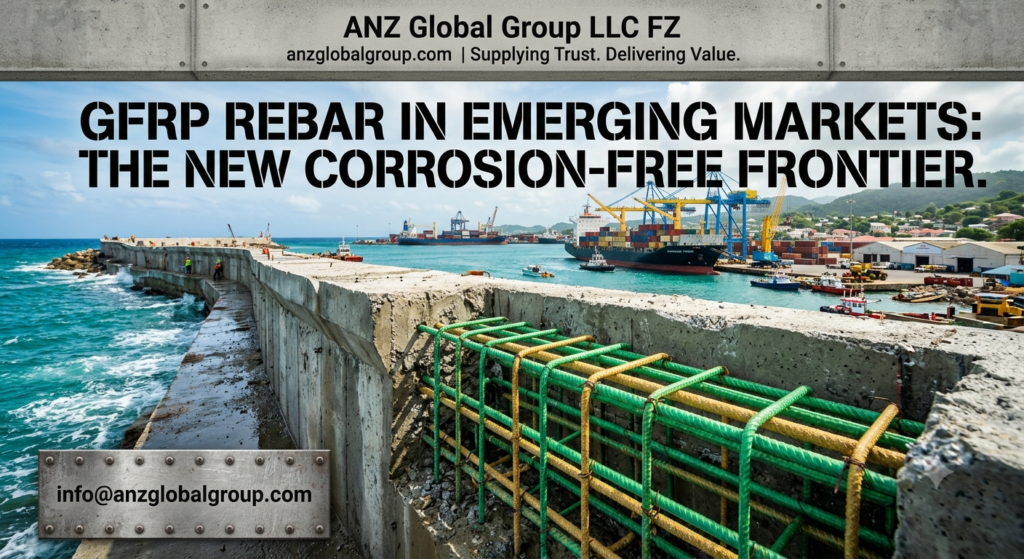
- Port and maritime infrastructure. Expanding oil production and export activity is driving significant port infrastructure development — jetties, quay walls, container handling facilities, marine support bases, and coastal logistics infrastructure — all in direct marine exposure.
- Water and sanitation infrastructure. Rapidly growing urban populations and oil-revenue-funded public infrastructure programmes are generating demand for water treatment plants, sewage systems, and utility infrastructure — environments where GFRP’s corrosion immunity and chemical resistance are directly applicable.
- Energy infrastructure. Gas-to-energy projects, power plant construction, and associated civil works are active across the region — creating demand for non-conductive, corrosion-resistant reinforcement in transformer foundations, power plant structures, and electrical infrastructure.
Real Deployment Is Already Happening
The GFRP adoption story in the Caribbean is no longer theoretical. In 2025, Rebella Caribbean Composite Rebar Ltd deployed GFRP rebar in a coastal seawall and flood defence project in the Caribbean — a directly relevant demonstration of real-world applicability in the region’s most demanding environmental conditions. The project highlighted both the material’s suitability for Caribbean coastal environments and the emergence of regional supply capability focused specifically on this market.
Caribbean airports are also actively evaluating GFRP for runway and apron pavements, seawall infrastructure, and radar-zone concrete works — where the material’s combination of corrosion resistance and electromagnetic neutrality addresses two separate specification requirements simultaneously. Salt spray, humidity, and heat in Caribbean airport environments make steel reinforcement maintenance an ongoing operational cost. GFRP eliminates that cost.
These are not pilot programmes or experimental applications. They are commercial construction decisions made by contractors and developers who have concluded that GFRP’s lifecycle cost profile is more favourable than steel’s in these specific environments — which is exactly the specification journey that GCC and African markets have been on for the past decade.
Why Emerging Markets Are Different to Source For
The specification of GFRP in an emerging market construction project and the procurement of it are two separate challenges. In established markets — North America, Europe, Australia — a contractor specifying GFRP for a bridge deck or coastal structure has access to local or regional distributors, established supply relationships, and well-understood logistics chains.
In the Caribbean and northern South America, that supply infrastructure is at an early stage. The number of established GFRP distributors with regional presence is limited. Import logistics from major manufacturing centres in Asia require international sourcing capability, documentation coordination, and customs navigation that local construction supply chains are not yet structured to handle efficiently.
This is where a sourcing partner with established international supply coordination experience — across multiple product categories, multiple manufacturing regions, and multiple destination markets — adds value that a regional building materials supplier cannot.
The same documentation discipline, inspection coordination, logistics management, and delivery follow-up that ANZ Global Group applies to OCTG supply into African markets applies directly to GFRP supply into Caribbean and Latin American project destinations. The product category is different. The supply execution challenge is structurally similar — and ANZ’s model is built for it.
For contractors and developers in the Caribbean and northern South America who have a GFRP specification in hand and no established supply channel, ANZ’s role is not peripheral. It is the practical bridge between a material specification and a delivered, document-compliant consignment on a project timeline.
The Standards Framework
GFRP rebar for Caribbean and Latin American projects is typically specified against international standards given the limited development of region-specific specifications:
- ASTM D7957 / D7959M — the primary US standard, widely referenced in Caribbean markets given US engineering influence and proximity
- ASTM D8505 / D8505M — covering surface deformation and bond characteristics, referenced on more technically specified projects
Structural design under ACI 440.1R-15 and ACI 440.11-2022 — both American Concrete Institute publications — is the standard engineering framework used across Caribbean and Latin American project markets, given the region’s engineering education and practice alignment with North American codes.
For projects with European financing or engineering involvement, FIB Bulletin 40 and relevant European standards may apply.
A Market at the Right Stage
The most compelling characteristic of the Caribbean and northern South American GFRP market is its timing. These markets are at exactly the stage where specification decisions are being made for infrastructure that will serve the next 50 to 80 years — in environments where the case for corrosion-free reinforcement is straightforward, during a construction boom that is generating real procurement volumes, at a moment when local supply infrastructure is still forming.
The procurement teams and contractors working on infrastructure projects in this region today are making material specification decisions that will define their projects’ maintenance trajectories for decades. Getting those decisions right — and sourcing the right material, correctly specified and properly documented, on project timelines — is where the value of an experienced international sourcing partner is most clearly demonstrated.
Working With ANZ Global Group
ANZ Global Group’s Advanced Reinforcement Solutions vertical sources GFRP rebar for infrastructure developers, contractors, and project teams across emerging and international markets through quality-oriented manufacturer partnerships — with the logistics, documentation, and supply coordination capability to serve markets where established local supply chains are limited.
- Email: info@anzglobalgroup.com
- UAE: +971 50794 4739
- India: +91 86799 58783
- USA: +1-301-915-0995
- Website: www.anzglobalgroup.com
Supplying Trust. Delivering Value.