Published by ANZ Global Group LLC FZ | anzglobalgroup.com
Two quotations arrive for the same OCTG requirement. One is 6% cheaper.
On a spreadsheet, the decision looks obvious. In practice, it rarely is.
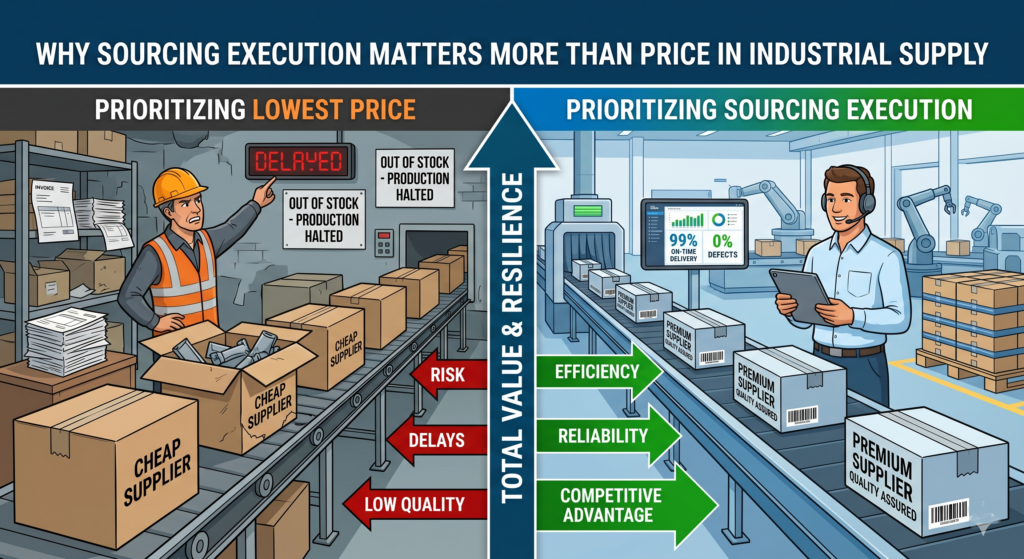
The cheaper quotation says nothing about whether that manufacturer will hold the delivery schedule, whether the mill certificates will match what was ordered, or whether the shipment will clear customs without incident. Procurement disruptions are now costing organizations an average of USD 16 million annually — and the suppliers behind those disruptions are rarely the most expensive option on the table. They are usually the cheapest.
This is not an argument against competitive pricing. It is an argument for asking what the material actually costs once everything is accounted for.
Price Is a Number. Cost Is a Process.
The purchase price is the easiest figure in procurement to compare — and the least complete. It says nothing about production capacity, documentation accuracy, or what happens if a shipment is rejected at port.
77% of procurement executives now cite supply disruption as their most critical external risk — ahead of cost inflation, ahead of currency exposure. A lower unit price that hides a documentation gap, a missed inspection, or an unrealistic lead time is not a saving. It is a liability that has not yet materialized, and one that typically surfaces with the least warning and the least room to absorb it.
In industrial supply, where a missed delivery window can stall a drilling campaign or delay a pipeline tie-in, the invoice price is only the opening line of the real cost.
What Execution-Focused Sourcing Looks Like
This is not a case for paying more without reason. It is a case for evaluating sourcing on what actually gets delivered, not just what gets quoted. Before placing the order, a few questions matter more than the price line:
- Is the manufacturer’s certification genuinely current for this product and grade — not just claimed?
- Has the lead time been confirmed against real production capacity, not sales eagerness?
- Are inspection and documentation requirements agreed before production starts, not negotiated after a problem appears?
- Is someone actively managing this process — coordinating inspection, verifying documentation, tracking the shipment — or is the order placed and simply hoped for?
These questions cost nothing to ask. Not asking them is where the real cost begins.
Where This Matters Most
In markets like the GCC and Africa, project timelines are fixed and mobilization windows do not move. A drilling contractor waiting on casing, or an EPC team waiting on flanges for a pipeline tie-in, cannot absorb a six-week customs delay over a missing document.
This is where execution — not price — determines whether a supply relationship holds up.
ANZ Global Group’s approach has never been to compete purely on unit price. It has been to manage the full supply cycle — manufacturer qualification, inspection coordination, documentation discipline, and delivery follow-up — so the number on the quotation is also the number that holds true at the end of the project.
That is the difference between a supplier and a sourcing partner.
Working With ANZ Global Group
ANZ Global Group LLC FZ is a Dubai-based industrial sourcing and supply company serving oil and gas, drilling, infrastructure, and advanced materials sectors across GCC, Africa, CIS, and international markets.
For sourcing inquiries, technical requirements, or project supply discussions, contact our team at:
- Email: info@anzglobalgroup.com
- UAE: +971 50794 4739
- India: +91 86799 58783
- USA: +1-301-915-0995
- Website: www.anzglobalgroup.com
Supplying Trust. Delivering Value.