
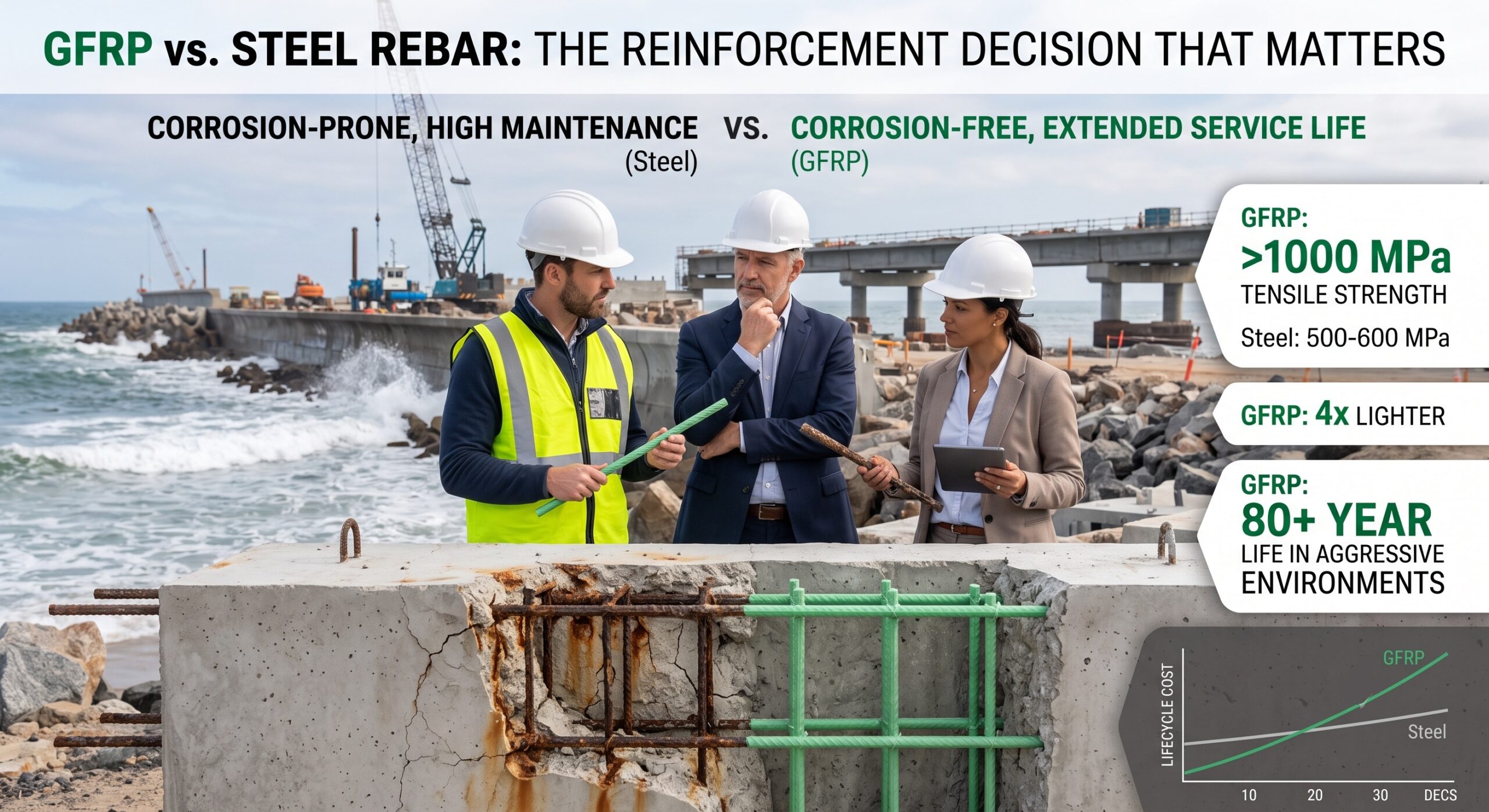
Steel has reinforced concrete structures for over a century. It is familiar, widely available, and well understood across the construction industry.
It also corrodes.
Corrosion-related infrastructure damage now costs the global construction and maintenance sector more than USD 2.5 trillion annually — and a significant portion of that cost traces directly back to steel reinforcement degrading inside concrete structures exposed to moisture, chlorides, and aggressive environments.
This is the problem that Glass Fibre Reinforced Polymer (GFRP) Rebar was engineered to solve. And it is why the global GFRP rebar market is growing at 12.1% annually, projected to nearly double from USD 0.54 billion in 2025 to USD 0.95 billion by 2030 — driven by infrastructure developers, contractors, and governments actively looking for reinforcement materials that last longer and cost less to maintain.
This post lays out what GFRP rebar is, how it compares to steel, and where it makes the strongest case for itself.
What GFRP Rebar Actually Is
GFRP rebar is a composite reinforcement bar manufactured from high-strength glass fibres embedded in a polymer resin matrix. It is designed as a direct structural alternative to conventional steel rebar in reinforced concrete — same function, fundamentally different material behaviour.
The key distinction is what happens over time. Steel, when exposed to moisture, chlorides, or chemically aggressive conditions, corrodes. As it corrodes, it expands — cracking the concrete around it, accelerating structural deterioration, and generating maintenance costs that continue for the life of the structure. GFRP does not corrode. It does not rust, it does not expand, and it does not degrade in the environments where steel consistently fails.
The Comparison That Matters
Specifying a reinforcement material is not a single-variable decision. Here is how the two materials compare across the factors that actually affect project and lifecycle outcomes:
Tensile Strength GFRP rebar delivers tensile strength exceeding 1000 MPa — significantly higher than the 500–600 MPa typical of conventional steel rebar. On a strength-to-weight basis, the advantage is even more pronounced.
Weight GFRP is approximately four times lighter than steel, with a density of around 1.9 T/m³ compared to steel’s 7.8 T/m³. For large-scale projects, this translates directly into reduced transportation costs, easier on-site handling, and lower dead load on structures.
Corrosion Resistance Steel is corrosion-prone by nature. GFRP is fully corrosion-free in any environment — marine, coastal, underground, chemical, or high-humidity. This is not a marginal improvement. It is the elimination of the single largest cause of premature structural deterioration.
Maintenance Requirements Steel structures in aggressive environments require ongoing corrosion management — inspection, treatment, repair — throughout their service life. GFRP structures require none of this. The maintenance cost difference over a 30–50 year project life is substantial.
Design Life GFRP carries a design life of 80 years and above under normal operational conditions. Steel’s effective service life in corrosive environments is considerably shorter and heavily dependent on maintenance activity.
Electrical and Magnetic Properties GFRP is electrically non-conductive and non-magnetic. For hospitals, MRI facilities, power plants, airports, and transformer foundations — where electromagnetic neutrality is a project requirement — this is not a preference. It is a specification.
Upfront Cost Steel typically costs less per tonne at point of purchase. This is the one area where steel holds a straightforward advantage — and it is also the most commonly misapplied factor in reinforcement decisions.
The Upfront Cost Question
The price-per-tonne comparison between GFRP and steel is real, and it should not be dismissed. For projects where corrosion is not a material risk and design life requirements are modest, steel may remain the right choice.
But for projects where corrosion is a genuine factor — coastal structures, marine infrastructure, water treatment facilities, underground construction, chemical environments — the upfront price comparison is the wrong frame.
The correct question is: what does this structure cost to build, maintain, and repair over its intended service life?
When that calculation is made honestly, GFRP’s higher purchase price is typically offset within the first decade through eliminated maintenance costs, reduced repair cycles, and extended service life — before the structural longevity advantage even begins to compound.
This is the lifecycle cost argument, and it is increasingly the argument that wins specification decisions on projects where long-term asset performance is the objective.
Where GFRP Makes the Strongest Case
GFRP rebar is not a universal replacement for steel. It is, however, the stronger choice across a clearly defined set of environments and applications:
Marine and coastal infrastructure — sea walls, jetties, marine precast, intertidal zones, splash zones — where chloride exposure is constant and steel corrosion is effectively inevitable.
Water and wastewater infrastructure — water treatment plants, underground tanks, sewage facilities — where chemical exposure and moisture are permanent conditions.
Transport infrastructure in corrosive environments — bridge decks, approach slabs, highway structures in de-icing salt regions or coastal zones.
Specialized facilities — hospitals and MRI suites requiring electromagnetic neutrality, power plants and transformer foundations requiring non-conductivity, airports with compass calibration requirements.
Industrial applications — chemical plants, ETP plants, cold storage, and facilities where the operating environment would degrade steel reinforcement over time.
In each of these contexts, the question is not whether GFRP costs more than steel today. It is whether specifying steel creates a maintenance and repair liability that will cost far more across the project’s life.
ANZ Global Group’s Position in GFRP Supply
ANZ Global Group’s Advanced Reinforcement Solutions vertical connects infrastructure developers, contractors, and project teams with GFRP rebar sourced through quality-oriented manufacturer partnerships across Asia and international markets.
Supply is available in diameters from 3mm to 25mm, in standard 12-metre lengths and coil options, compliant with ASTM D7957/D7959M, IS 18256:2023, AS 5204:2023, and IRC 137-2022, with design references under ACI 440.1R-15, ACI 440.11-2022, and FIB Bulletin 40.
The same execution-focused sourcing model applied across ANZ’s Oil & Gas supply operations — documentation support, manufacturer qualification, logistics coordination, and delivery follow-up — is applied directly to GFRP supply.
For project teams evaluating GFRP for an upcoming requirement, ANZ’s team is available to discuss specifications, sourcing timelines, and supply options.
Working With ANZ Global Group
ANZ Global Group LLC FZ is a Dubai-based industrial sourcing and supply company serving oil and gas, drilling, infrastructure, and advanced materials sectors across GCC, Africa, CIS, and international markets.
Email: info@anzglobalgroup.com UAE: +971 50794 4739 India: +91 86799 58783 USA: +1-301-915-0995 Website: www.anzglobalgroup.com
Supplying Trust. Delivering Value.