Published by ANZ Global Group LLC FZ | anzglobalgroup.com
OCTG procurement looks straightforward on paper. You have a well programme, a tubular specification, a delivery window, and a budget. You issue an RFQ, receive quotations, and select a supplier.
The difficulty is that an OCTG quotation tells you very little about whether that supplier can actually deliver — the right grade, on schedule, with documentation that will pass inspection and clear customs without issue.
The global OCTG market is valued at USD 25.7 billion in 2025 and growing at 6.7% annually, driven by rising upstream activity across North America, the Middle East, and Africa. In ANZ’s core markets alone — the Middle East and Africa — OCTG demand reached USD 7.13 billion in 2025, supported by active drilling programmes from Saudi Aramco and ADNOC through to Nigerian and Angolan upstream operations. That level of market activity means manufacturers are busy, lead times are real, and the gap between a confident quotation and an on-time, compliant delivery is wider than it appears.
This guide covers what procurement teams should actually be evaluating when selecting an OCTG supplier — beyond the price column.
1. API Certification: Current, Applicable, and Verifiable
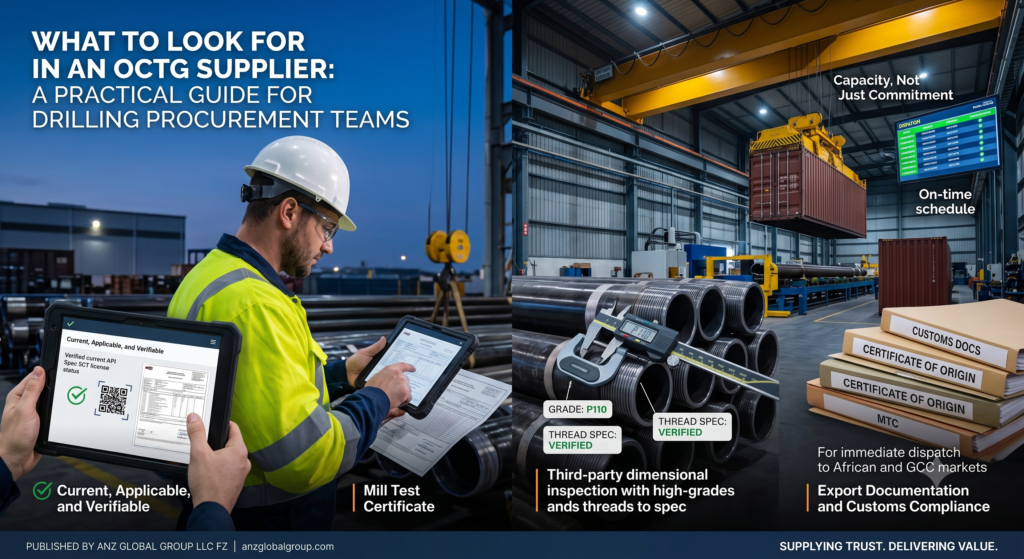
API SPEC 5CT governs casing and tubing. API SPEC 5DP governs drill pipe. These are not optional standards in OCTG procurement — they are the baseline for product integrity, safety, and acceptance by operators and inspection agencies.
The critical word here is current. An API licence has a scope — specific product types, grades, and sizes covered — and a validity period. A mill that holds API 5CT certification for J55 and K55 casing is not automatically certified for P110 or Q125. A licence that expired and was not renewed is no licence at all.
Before placing an order, confirm:
- That the mill holds a current, valid API licence for the specific product and grade being ordered
- That the licence scope covers the OD and wall thickness ranges required
- That the licence can be independently verified — API’s published licensee directory is publicly available and takes minutes to check
A supplier who cannot provide verifiable API certification for the specific product being ordered should not proceed further in the evaluation.
2. Grade Availability vs. Grade Capability
OCTG grades are not interchangeable. J55 and K55 are common and widely available. L80, C90, T95, P110, and Q125 represent progressively tighter chemistry, mechanical, and heat treatment requirements — and not every mill that quotes them can actually produce them to specification consistently.
The distinction between quoting a grade and producing it reliably is real and meaningful. It shows up in mill certificate review, in third-party inspection results, and occasionally in material that fails downhole.
Questions worth asking at the quotation stage:
- What is this mill’s production history for this specific grade?
- Can they provide MTCs from recent comparable production runs?
- Is this grade within their standard product range, or a special order they are less familiar with?
A mill that specializes in the grades you need — rather than one that claims availability across the full grade range — is generally a lower-risk source.
3. Mill Test Certificates: Not Just a Document Requirement
Mill Test Certificates are the documentary record of the material supplied — heat and lot traceability, chemical composition, mechanical test results, hydrostatic test data, and dimensional conformance. For most operators and project owners, MTCs are a contractual requirement for material acceptance.
They are also the most commonly problematic element in international OCTG supply.
Issues that surface regularly: heat numbers on the MTC that do not trace to the delivered material. Mechanical test values that meet the standard but were recorded from a different production batch. Missing heat treatment records for grades that require it. These are not hypothetical risks — they are common enough that experienced procurement teams treat MTC verification as a standard step, not an afterthought.
What to confirm before and during the order:
- MTCs must reference the specific heat and lot numbers of the material being shipped
- Results must meet API SPEC 5CT requirements for the grade ordered — not just the standard in general
- Third-party inspection should include MTC review as part of the release process, not just visual and dimensional checks
4. Third-Party Inspection: Coordinate It Before Production, Not After
Third-party inspection is one of the most effective risk management tools available in OCTG procurement. It is also one of the most commonly left to the last minute.
Inspection hold points — the points in the production and packing process where an independent inspector must sign off before work proceeds — need to be agreed with the manufacturer before production starts. Trying to introduce inspection requirements after production is complete reduces the exercise to a paperwork review rather than a genuine quality check.
For a standard OCTG consignment, inspection typically covers:
- Visual inspection for surface defects, end damage, and coupling condition
- Dimensional verification — OD, wall thickness, length, and drift diameter
- MTC review and heat/lot traceability confirmation
- Packing and marking inspection before loading
For critical grades or demanding downhole environments, additional witness testing may be required. The inspection agency — whether Bureau Veritas, TÜV SÜD, or another internationally recognized body — should be agreed between buyer and supplier at the PO stage, not introduced as an afterthought when the goods are ready to ship.
5. Delivery Reliability: Capacity, Not Just Commitment
A supplier can confirm a delivery date. Whether they can meet it is a different question.
Lead time reliability in OCTG procurement depends on actual production capacity — whether the mill has a confirmed slot for your order in their production schedule, not just the intention to fit it in. It depends on whether raw material is available or needs to be procured. It depends on whether threading and coupling operations are in-house or subcontracted, and what the queue looks like.
These are not questions that come back clearly from a standard RFQ. They require either a direct conversation with the mill, a supplier relationship that allows honest answers, or a sourcing partner with enough market presence to know what a given mill’s actual capacity situation looks like at any given time.
The question to ask is not “can you deliver by this date?” The question is “what is your current production backlog, and where does our order sit in it?”
6. Export Documentation and Customs Compliance
OCTG destined for African or GCC markets arrives in environments where documentation requirements are specific and strictly enforced. Missing or incorrect paperwork — country of origin certificates, packing lists that don’t match the physical consignment, export licences where required — can result in weeks of customs delay or outright rejection at port.
Documentation that needs to be confirmed before shipment:
- Commercial invoice and packing list, verified against the physical consignment
- Certificate of Origin, issued by the correct authority for the destination country’s requirements
- MTC copies accompanying the shipment
- Any destination-specific compliance certificates required by the client or end-user
Getting this right requires attention before the goods leave the mill — not when the vessel has already sailed.
Working With ANZ Global Group
ANZ Global Group LLC FZ sources OCTG products — casing, tubing, drill pipe, HWDP, drill collars, and crossovers — from API-licensed mills across Asia and the Middle East, for drilling contractors, EPC companies, and procurement teams operating across GCC, Africa, CIS, and international markets.
Supply coordination includes manufacturer qualification, inspection coordination through internationally recognized agencies, MTC and documentation management, logistics support, and delivery follow-up — the full cycle, not just the quotation.
For sourcing inquiries or project requirements, contact our team at:
- Email: info@anzglobalgroup.com
- UAE: +971 50794 4739
- India: +91 86799 58783
- USA: +1-301-915-0995
- Website: www.anzglobalgroup.com
Supplying Trust. Delivering Value.