
Published by ANZ Global Group LLC FZ | anzglobalgroup.com
The GCC is in the middle of one of the most sustained infrastructure build cycles in its history.
As of late 2025, the region had awarded approximately USD 249 billion in project contracts across construction, utilities, transport, and energy — tracking above its ten-year average and showing no signs of slowing. Saudi Arabia’s gigaproject pipeline alone has around USD 55 billion worth of contracts currently out for tender. The UAE, Qatar, Kuwait, and Oman are simultaneously advancing major developments across coastal, urban, industrial, and water infrastructure.
What this level of activity creates — beyond opportunity — is a long-term asset management challenge. Structures being built today will need to perform for 50, 60, 80 years or more. And in the GCC, the environment those structures will spend their entire service life in is one of the most aggressive on earth for conventional steel reinforcement.
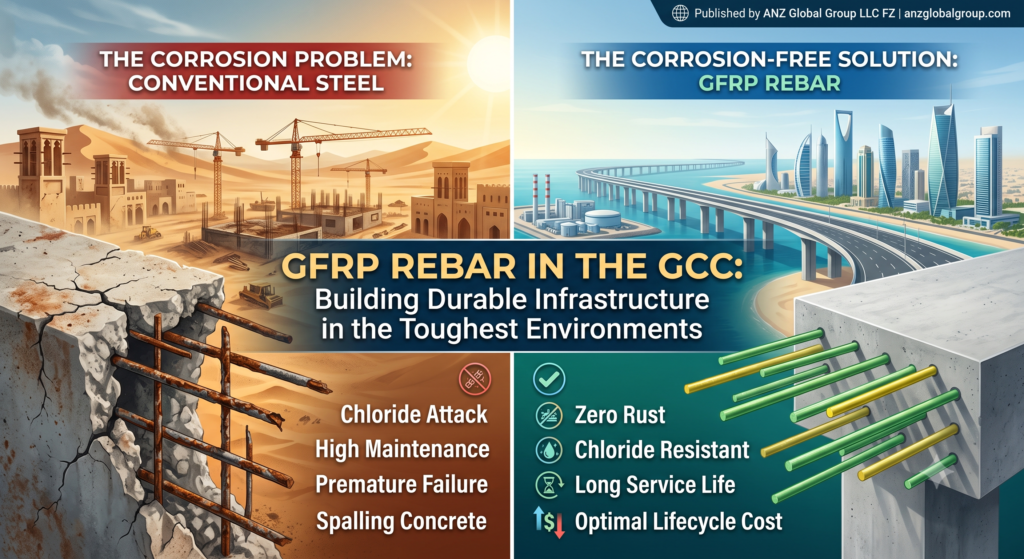
The GCC’s Corrosion Problem Is Not a Minor Variable
The GCC’s construction environment combines several corrosion risk factors simultaneously — and unlike most regions, it combines them at scale.
- Coastal exposure: A significant proportion of GCC infrastructure sits on or near coastlines. The Arabian Gulf, the Red Sea, and the Gulf of Oman create extensive marine exposure zones where chloride-laden air, seawater splash, and tidal conditions attack concrete structures continuously. Chloride-induced corrosion is the primary durability challenge for marine and coastal infrastructure globally — and the GCC has more coastline-adjacent construction activity than almost any comparable region.
- Humidity and temperature cycling: Even inland GCC structures face extreme thermal cycling — temperatures swinging from below 20°C in winter to above 50°C in summer — combined with periodic high humidity. These conditions accelerate the rate at which moisture and chlorides penetrate concrete cover and reach embedded steel reinforcement.
- Groundwater salinity: Saline groundwater is common across much of the GCC subsoil. For underground structures — foundations, basements, tunnels, utility vaults — this means steel reinforcement is exposed to chloride attack from below as well as above.
- Desalination and water infrastructure: The GCC depends on desalination for the majority of its fresh water supply. Water treatment plants, storage tanks, distribution networks, and wastewater facilities operate in chemically aggressive environments by definition — environments where steel reinforcement has a consistently poor service record.
The consequence of all this is predictable: structures reinforced with conventional steel in the GCC deteriorate faster than their design life suggests, generate higher maintenance costs than initially projected, and in some cases require major rehabilitation within 20–30 years of construction. The cost of that deterioration — inspection, treatment, repair, and in some cases reconstruction — is substantial and largely avoidable.
What Corrosion-Free Reinforcement Changes
GFRP rebar does not corrode. It does not rust, it does not expand inside concrete when exposed to moisture and chlorides, and it does not initiate the cracking and spalling cycle that drives the maintenance burden on steel-reinforced structures in aggressive environments.
In the GCC context specifically, this matters across several infrastructure categories:
- Coastal and marine structures: Sea walls, breakwaters, marine precast, jetties, coastal road infrastructure, and intertidal zones. These are the structures most exposed to chloride attack and the ones where steel reinforcement fails fastest. GFRP’s complete corrosion immunity means these structures can perform to their full design life without the intervention cycles that steel demands.
- Water and wastewater infrastructure: Treatment plants, storage tanks, underground reservoirs, and distribution infrastructure. Chemical exposure in these environments is continuous and aggressive. GFRP’s resistance to chemical attack, combined with its non-reactive surface, makes it the more durable long-term choice.
- Underground foundations and structures: In saline soil or groundwater conditions, conventional steel requires protective measures and regular inspection. GFRP eliminates the corrosion risk at source.
- Specialized facilities: Hospitals, MRI facilities, airports, power plants, and transformer foundations where GFRP’s electrical non-conductivity and non-magnetic properties meet specification requirements that steel simply cannot satisfy.
- Urban and transport infrastructure: Bridges, elevated roads, tunnels, and parking structures in coastal cities where de-icing chemicals are not the issue but marine air and humidity are.
The Lifecycle Cost Argument in a High-Activity Market
In a market building at the pace and scale of the GCC, the upfront cost comparison between GFRP and steel is the natural starting point for any conversation. GFRP carries a higher purchase price per tonne — that is a straightforward fact.
What it does not carry is the lifecycle cost that steel accumulates in aggressive GCC environments.
A coastal structure reinforced with conventional steel will typically require corrosion inspection and maintenance activity within 15–25 years. A structure requiring major rehabilitation or partial reconstruction within 30–40 years is not unusual in high-exposure GCC environments. The cumulative cost of those interventions — across the structure’s intended 60–80 year service life — routinely exceeds the upfront premium of specifying GFRP at the design stage.
For project developers, asset owners, and government bodies making long-term infrastructure investment decisions in the GCC, the lifecycle cost frame is increasingly the correct one. A structure that costs slightly more to build but significantly less to maintain and runs to its full design life without unplanned rehabilitation is a better infrastructure investment — particularly in a region building assets designed to serve the next generation.
Standards and Specification
GFRP rebar supplied through ANZ Global Group is available in compliance with the international standards relevant to GCC and international project specifications:
- ASTM D7957 / D7959M
- IS 18256 : 2023
- AS 5204 : 2023
- IRC : 137-2022
Design references under ACI 440.1R-15, ACI 440.11-2022, and FIB Bulletin 40 support structural specification and engineering design integration.
Product is available in diameters from 3mm to 25mm in straight bar form, and 3mm to 12mm in coil options at standard lengths of 12, 50, and 100 metres. Custom bent shapes are available on request.
ANZ Global Group’s Position in GCC GFRP Supply
ANZ Global Group is actively developing its Advanced Reinforcement Solutions supply capability for GCC markets — connecting infrastructure developers, contractors, and project teams with GFRP rebar sourced through quality-oriented manufacturer partnerships across Asia and international markets.
For project teams in the GCC evaluating GFRP rebar for upcoming requirements — whether at specification stage, procurement stage, or early commercial discussion — ANZ’s team is available to discuss product options, sourcing timelines, and supply coordination.
Working With ANZ Global Group
ANZ Global Group LLC FZ is a Dubai-based industrial sourcing and supply company serving oil and gas, drilling, infrastructure, and advanced materials sectors across GCC, Africa, CIS, and international markets.
For inquiries, contact our team at:
- Email: info@anzglobalgroup.com
- UAE: +971 50794 4739
- India: +91 86799 58783
- USA: +1-301-915-0995
- Website: www.anzglobalgroup.com
Supplying Trust. Delivering Value.