
Published by ANZ Global Group LLC FZ | anzglobalgroup.com
Steel corrosion in saltwater environments costs the global economy more than USD 2.5 trillion annually. Marine corrosion alone — the subset affecting coastal and offshore structures specifically — accounts for an estimated USD 30 to 50 billion per year in direct losses to asset owners, operators, and governments.
These numbers are large enough to be difficult to connect to an individual project decision. So consider them at the project level instead.
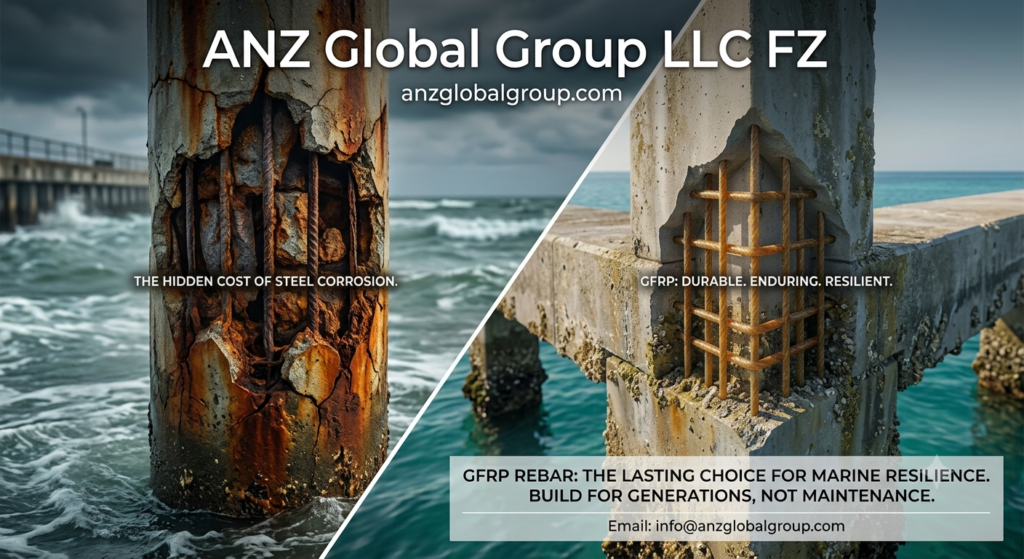
A coastal bridge reinforced with conventional steel in a chloride-rich environment begins to show cracking and spalling within 15 to 25 years — not because it was poorly built, but because the reinforcement material was never suited to the environment it was placed in. Repair costs for a mid-life concrete structure in an advanced state of corrosion-induced deterioration routinely run to 30–60% of the original construction cost. In some cases, full reconstruction is required before the structure has reached half its intended service life.
This is the hidden cost of steel corrosion in coastal and marine construction. It does not appear on the original project budget. It appears 15 years later, when the maintenance cycle begins.
Why Coastal and Marine Environments Are So Aggressive
Steel corrodes in most environments given enough time. In coastal and marine environments, the process is dramatically accelerated — and the reason is the combination of factors acting simultaneously:
- Chloride penetration. Chloride ions from seawater and marine air penetrate concrete cover and reach embedded steel reinforcement, breaking down the passive oxide layer that normally protects steel from corrosion. Once that passive layer is compromised, active corrosion begins and accelerates. “Physical infrastructure in coastal and offshore locations is prone to marine corrosion even with the application of protective coatings and cathodic protection” — meaning that the standard protective measures applied to steel slow the process but do not stop it.
- Electrochemical environment. Seawater is a highly conductive electrolyte rich in dissolved salts and oxygen — near-ideal conditions for the electrochemical process that drives steel corrosion. Exposure is continuous and unavoidable for structures built in or adjacent to marine environments.
- Thermal cycling. In regions like the GCC, extreme temperature variation between seasons accelerates the rate at which concrete expands and contracts, opening micro-cracks that allow moisture and chlorides deeper penetration over time.
- Splash and tidal zones. Structures in intertidal and splash zones experience the most aggressive corrosion conditions — repeated wetting and drying cycles that concentrate chloride deposits on concrete surfaces and accelerate penetration into the structure.
The consequence of all these factors acting together is a deterioration timeline significantly shorter than design life assumptions built on standard inland conditions. A structure designed for 60 years in an aggressive coastal environment, reinforced with conventional steel, may realistically require major intervention within 20 to 30 years.
What Corrosion-Induced Deterioration Actually Costs
The cost of steel corrosion in reinforced concrete structures is not just the cost of the corroding reinforcement. It is the cascading cost of what corrosion does to the structure around it.
As steel corrodes, it expands — up to eight times its original volume in advanced corrosion states. That expansion cracks the surrounding concrete. Cracked concrete allows faster chloride and moisture penetration, which accelerates corrosion further. Spalling follows — pieces of concrete detaching from the structure surface, exposing the corroded reinforcement and compromising structural integrity.
By the time visible deterioration is apparent, the underlying corrosion process has typically been active for years. Intervention at this stage is no longer a maintenance activity. It is structural rehabilitation — and it is expensive.
Typical intervention costs for corrosion-affected coastal structures include:
- Concrete removal and replacement in affected zones.
- Corroded reinforcement cleaning, treatment, or replacement.
- Protective coating or cathodic protection system installation or renewal.
- Structural assessment, monitoring, and certification.
- In severe cases, partial or full reconstruction.
None of these costs were in the original project budget. All of them could have been substantially reduced or eliminated by a different reinforcement specification at the design stage.
The Material Decision That Changes the Calculation
GFRP rebar does not corrode. It does not react to chloride exposure, it does not expand inside concrete, and it does not initiate the cracking and spalling cycle that drives coastal structure deterioration.
This is not a marginal performance difference. It is the elimination of the primary failure mechanism for reinforced concrete in marine and coastal environments.
The practical implications are direct:
- A coastal structure reinforced with GFRP does not require corrosion inspection cycles.
- It does not accumulate a maintenance liability that grows with every year of marine exposure.
- It does not reach a mid-life intervention point where rehabilitation costs approach reconstruction costs.
- It performs consistently to its design life — 80 years and above under normal operational conditions — without the intervention cycles that steel demands.
The upfront material cost of GFRP is higher than conventional steel rebar. That cost difference is real and should be part of any honest specification discussion.
What should also be part of that discussion is the lifecycle cost calculation — what the structure will cost to build, maintain, inspect, repair, and ultimately replace over its intended service life. When that calculation is made honestly for structures in aggressive coastal and marine environments, the reinforcement material that costs more at the design stage is frequently the one that costs less over the life of the asset.
Where This Applies
The case for GFRP over steel in coastal and marine construction is strongest — and most straightforward — across several application categories:
- Marine infrastructure: sea walls, breakwaters, jetties, marine precast panels, and intertidal zone structures where chloride exposure is constant and steel corrosion is not a risk to be managed but a certainty to be planned for.
- Coastal transport infrastructure: bridge decks and approach slabs, coastal highways, crash barriers, and tunnel structures in marine-air environments where de-icing salt or direct chloride exposure accelerates deterioration.
- Water and wastewater infrastructure: treatment plants, underground reservoirs, storage tanks, and distribution structures where chemical exposure and moisture are permanent operating conditions.
- Port and harbour infrastructure: wharves, quay walls, fender systems, and port facility structures operating continuously in saltwater environments.
- Coastal energy and industrial facilities: power plants, desalination facilities, chemical processing plants, and industrial structures in coastal locations where both chloride exposure and chemical environments are factors.
In each of these categories, the reinforcement material decision made at the design stage determines the maintenance trajectory and total lifecycle cost of the asset. Specifying steel in these environments does not eliminate the corrosion problem — it defers its cost.
ANZ Global Group’s GFRP Supply Capability
ANZ Global Group’s Advanced Reinforcement Solutions vertical sources GFRP rebar for infrastructure developers, contractors, and project teams across GCC, Africa, and international markets through quality-oriented manufacturer partnerships.
Supply is available from 3mm to 25mm diameter in straight bar form and 3mm to 12mm in coil options, compliant with ASTM D7957/D7959M, IS 18256:2023, AS 5204:2023, and IRC 137-2022, with design references under ACI 440.1R-15, ACI 440.11-2022, and FIB Bulletin 40.
For project teams evaluating reinforcement specifications for coastal, marine, or aggressive-environment applications, ANZ’s team is available to discuss product options, sourcing timelines, and supply coordination.
Working With ANZ Global Group
ANZ Global Group LLC FZ is a Dubai-based industrial sourcing and supply company serving oil and gas, drilling, infrastructure, and advanced materials sectors across GCC, Africa, CIS, and international markets.
- Email: info@anzglobalgroup.com
- UAE: +971 50794 4739
- India: +91 86799 58783
- USA: +1-301-915-0995
- Website: www.anzglobalgroup.com
Supplying Trust. Delivering Value.