
Published by ANZ Global Group LLC FZ | anzglobalgroup.com
The global water and wastewater treatment sector is in the middle of a sustained capital deployment cycle unlike anything seen in the previous generation.
The global market is projected to grow from USD 372 billion in 2025 to USD 714 billion by 2034. The World Bank estimates that meeting global water and sanitation infrastructure commitments by 2030 will require mobilising up to USD 7 trillion — the bulk of it in developing countries across Asia, Africa, and the Middle East. In ANZ’s core markets specifically, the Middle East and Africa are forecast to see solid growth driven directly by water and wastewater treatment buildouts addressing water scarcity, rapid urbanisation, and expanding industrial demand.
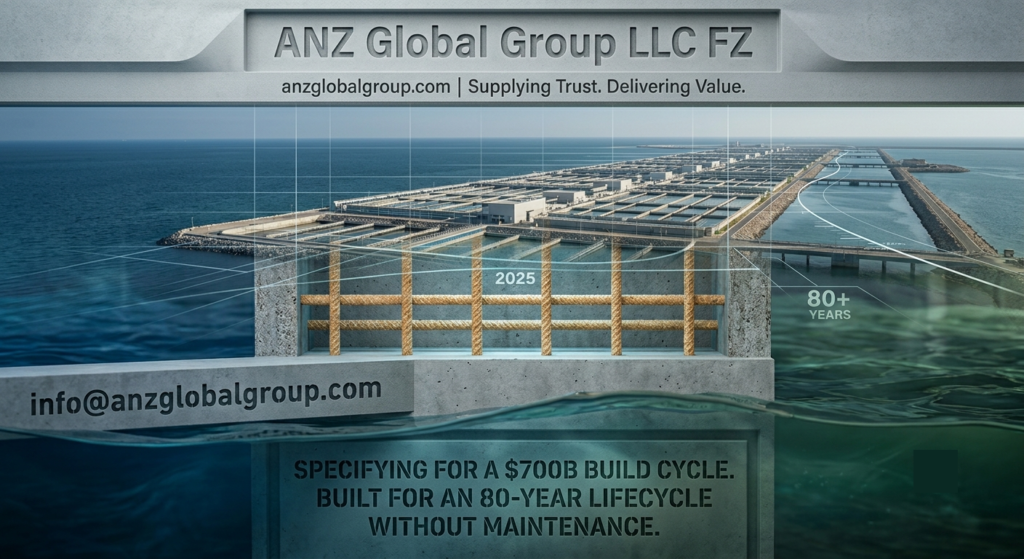
What this investment cycle is building — treatment plants, underground reservoirs, sewage facilities, desalination infrastructure, effluent treatment systems — will serve communities and industries for the next 50 to 80 years. The material decisions made at the design stage today will determine whether those assets perform to their intended life, or accumulate a maintenance liability that grows with every year of operation.
This is where reinforcement material selection matters — and where GFRP rebar is increasingly becoming the specification of choice for engineers and developers who are thinking beyond the upfront bill of materials.
The Problem With Steel in Water Infrastructure Environments
Water and wastewater structures are not simply wet. They are chemically, biologically, and mechanically aggressive environments — often simultaneously — and conventional steel reinforcement has a consistently poor service record in them.
Treatment chemicals. Water treatment processes use chlorine, chloramines, and acids. Wastewater and effluent treatment facilities handle hydrogen sulphide, organic acids, ammonia, and industrial chemicals depending on process type. These compounds attack both concrete and embedded steel reinforcement.
Biogenic acid attack. In sewage environments, sulphate-reducing bacteria generate hydrogen sulphide gas, which dissolves in surface condensation to form sulphuric acid. This biogenic acid attack degrades concrete aggressively and dramatically accelerates steel corrosion in enclosed wastewater structures.
Permanent moisture. Unlike structures that experience periodic wetting and drying, water infrastructure is in continuous contact with water. Moisture penetration through concrete cover is constant — creating an uninterrupted pathway for chemical attack on embedded reinforcement.
High-salinity conditions. Desalination plants and brine handling infrastructure operate with extreme chloride concentrations. For steel reinforcement, this represents one of the most aggressive operating environments possible.
The outcome of these combined factors is predictable: steel-reinforced water infrastructure in chemically aggressive environments deteriorates faster than design life assumptions suggest, and generates maintenance and rehabilitation costs that were not in the original project budget. A treatment plant built today with conventional steel reinforcement will very likely require structural intervention well before its intended 50 or 60-year service life has elapsed.
What GFRP Changes for Water Infrastructure
GFRP rebar is not simply corrosion-resistant. It is corrosion-immune by composition. The glass fibre and polymer resin matrix does not participate in electrochemical corrosion reactions. It does not react to chloride exposure. It does not corrode in the acidic, alkaline, or chemically active environments typical of water and wastewater infrastructure. And critically, it does not expand inside concrete when exposed to moisture and chemicals — which means it does not initiate the cracking and spalling cycle that drives steel-reinforced structure deterioration.
For water infrastructure specifically, the practical implications are direct:
No corrosion-driven structural deterioration. The failure mechanism that shortens the service life of steel-reinforced water structures simply does not apply to GFRP. Structures maintain their integrity across the full design life without corrosion intervention.
Broad chemical resistance. GFRP demonstrates strong resistance across the chemical environments typical of water treatment, wastewater processing, effluent treatment, and desalination applications — including chlorinated water, moderately acidic conditions, sulphate-bearing environments, and high-salinity water.
Reduced concrete cover. Because corrosion risk is eliminated, GFRP-reinforced concrete can be designed with reduced cover compared to steel-reinforced equivalents in aggressive environments. Thinner sections reduce dead load and material consumption — a design efficiency that partially offsets GFRP’s higher unit cost.
Eliminated maintenance cycles. Steel-reinforced water infrastructure requires periodic corrosion inspection, protective coating renewal, crack repair, and in many cases reinforcement replacement. GFRP-reinforced structures require none of this. The maintenance liability does not accumulate.
Design life of 80 years and above. Under normal operational conditions, GFRP supports structural service life well beyond what steel can reliably deliver in chemically aggressive water environments.
Where the Case Is Strongest
GFRP’s advantage in water infrastructure is most pronounced across:
Water treatment plants — tanks, filter beds, clarifier structures, chemical dosing areas, and process basins where treatment chemical exposure is continuous and the operating environment is chemically active by design.
Sewage treatment plants — primary and secondary treatment structures, digesters, sludge handling facilities, and enclosed areas where biogenic acid attack is an active and ongoing deterioration mechanism.
Effluent treatment plants — industrial wastewater treatment infrastructure where chemical composition varies by process but aggressive exposure is the consistent factor across facility types.
Underground reservoirs and water tanks — structures in permanent ground contact, particularly in saline or chemically active soil and groundwater conditions where steel reinforcement faces attack from multiple directions simultaneously.
Desalination infrastructure — intake structures, brine handling systems, and pre and post-treatment facilities operating in extremely high chloride environments where steel’s service record is weakest.
Wastewater pumping stations — below-ground structures in continuous contact with sewage, moisture, and biologically generated acids — enclosed environments where deterioration conditions are most concentrated.
In each of these applications, the reinforcement decision at design stage determines the maintenance trajectory. Specifying GFRP does not just reduce maintenance cost — it changes the asset’s lifecycle profile fundamentally.
Thinking About the Investment Correctly
The global water infrastructure build cycle underway is not just about construction volume. It is about building assets that will serve the next generation — treatment plants, reservoirs, and sewage systems designed to perform for 50, 60, 80 years without the kind of mid-life rehabilitation that effectively means rebuilding what was already built.
The upfront cost of GFRP rebar is higher than conventional steel. That is a straightforward fact and should be part of any honest specification discussion.
What changes the calculation is the lifecycle frame. A water treatment plant reinforced with GFRP does not accumulate a corrosion-driven maintenance liability. It does not reach a 25-year intervention point where rehabilitation costs approach reconstruction costs. It performs to its design life — which is precisely what the scale of current global water infrastructure investment is trying to achieve.
For developers, asset owners, and governments committing capital to water infrastructure today, that lifecycle performance difference is increasingly the correct basis for reinforcement material selection.
ANZ Global Group’s GFRP Supply for Water Infrastructure
ANZ Global Group’s Advanced Reinforcement Solutions vertical sources GFRP rebar for infrastructure developers, contractors, and project teams through quality-oriented manufacturer partnerships, with supply available across the diameter range and specification requirements relevant to water and wastewater infrastructure applications.
Product is compliant with ASTM D7957/D7959M, IS 18256:2023, AS 5204:2023, and IRC 137-2022, with design references under ACI 440.1R-15, ACI 440.11-2022, and FIB Bulletin 40 — covering the standards referenced by engineers and project owners across GCC, Africa, and international markets.
For project teams evaluating GFRP rebar for water or wastewater infrastructure requirements, ANZ’s team is available to discuss product specifications, sourcing timelines, and supply coordination.
Working With ANZ Global Group
ANZ Global Group LLC FZ is a Dubai-based industrial sourcing and supply company serving oil and gas, drilling, infrastructure, and advanced materials sectors across GCC, Africa, CIS, and international markets.
Email: info@anzglobalgroup.com UAE: +971 50794 4739 India: +91 86799 58783 USA: +1-301-915-0995 Website: www.anzglobalgroup.com
Supplying Trust. Delivering Value.