Published by ANZ Global Group LLC FZ | anzglobalgroup.com
The product arrived on schedule. The delivery looked correct. Then the inspection team reviewed the documentation — and the consignment was put on hold.
This scenario is more common in international oil and gas supply than most procurement teams want to admit. Materials that are physically correct, dimensionally compliant, and produced to the right grade can still be rejected, delayed, or flagged for non-conformance because the paperwork does not hold up to scrutiny.
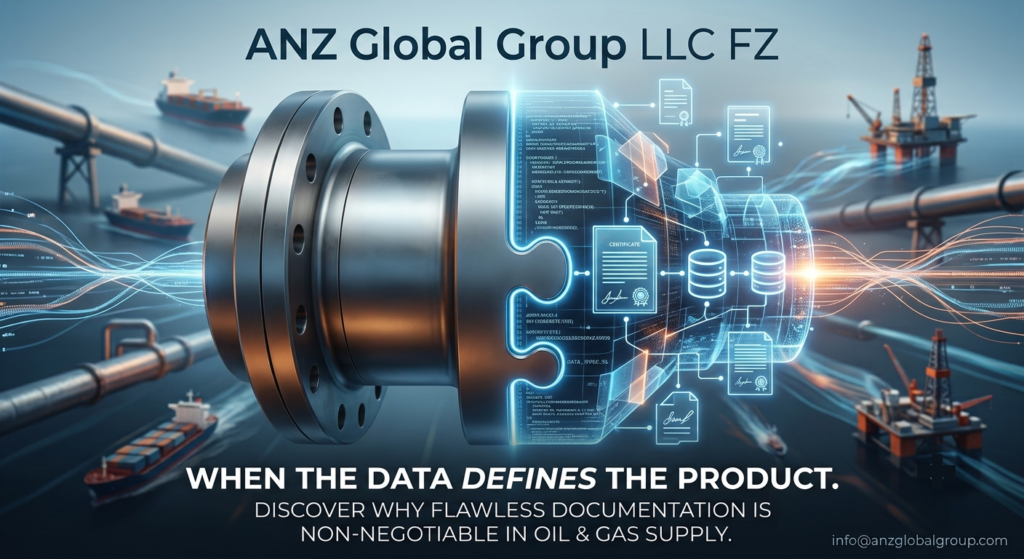
In O&G supply, documentation is not administrative overhead. It is part of the product.
What Documentation Actually Covers
For industrial materials supplied into oil and gas projects, the documentation package typically includes several distinct elements — each serving a specific purpose, and each carrying its own risk if handled incorrectly:
- Mill Test Certificates (MTCs) are the primary material traceability document. They record the chemical composition, mechanical test results, heat treatment conditions, and dimensional data for a specific production heat and lot. For OCTG, line pipe, flanges, and fittings, MTCs are not optional — they are a contractual requirement for material acceptance on almost every project.
- The critical point is traceability. The heat and lot numbers on the MTC must correspond directly to the physical material in the consignment. A certificate that cannot be traced to the actual delivered material — whether because lot numbers do not match, heats were mixed during packing, or certificates were reused from a different production run — is not a document. It is a liability.
- Third-party inspection reports provide independent verification that the material meets the specified requirements. These cover dimensional checks, visual inspection, MTC review, and witness testing where required. Inspection reports are the documentary record of what an independent agency confirmed — and in markets where operators and end-users require third-party sign-off before material acceptance, a missing or incomplete inspection report is a project delay waiting to happen.
- Export documentation includes commercial invoices, packing lists, certificates of origin, and any destination-specific compliance certificates. For African and GCC markets, these requirements are specific and strictly enforced. A packing list that does not match the physical consignment exactly, or a certificate of origin that does not meet the importing country’s requirements, can result in customs clearance delays measured in weeks rather than days.
- Compliance certificates cover product-specific requirements beyond the standard MTC — API monogram confirmation, PSL documentation for line pipe, thread inspection certificates for OCTG connections. These are often overlooked until a project’s inspection or acceptance team asks for them.
Where Documentation Failures Actually Occur
Understanding where documentation problems originate is more useful than simply knowing that they exist:
- At the mill. The most common source of MTC issues is the manufacturer. Heat numbers recorded incorrectly, test results from a representative sample presented as if they cover the entire lot, certificates issued for a grade or specification that does not exactly match what was produced. These errors are not always deliberate — but they are frequently the result of inadequate quality systems or insufficient oversight at source.
- During packing and loading. Mixed lots — where material from different heats is packed together without clear marking — create traceability gaps that are difficult to resolve after the fact. If the physical material cannot be matched to a specific heat on the MTC, the entire consignment’s traceability is compromised.
- In export documentation preparation. Commercial invoices, packing lists, and certificates of origin are frequently prepared by freight forwarders or export agents who may not be familiar with the specific documentation requirements of the destination country. Errors at this stage are common and often not discovered until the shipment arrives at port.
- At customs clearance. This is where the cumulative effect of earlier documentation gaps becomes a practical problem. A missing certificate, a discrepancy between the packing list and the physical count, or an incorrectly described product code can hold a shipment at port while the project team waits and the drilling schedule moves.
Why Traceability Is Non-Negotiable in O&G Supply
Material traceability in oil and gas supply is not simply a documentation preference. It is a safety and integrity requirement.
OCTG products installed in a well must be traceable from the producing mill through to the installed string. If a material failure occurs downhole, the ability to identify the source — the specific heat, the production lot, the mill, the inspection record — is essential for determining cause, liability, and corrective action.
“The oil and gas industry has long faced inefficiencies through unresolved processes and manual documentation” — and the cost of those inefficiencies shows up not just in procurement delays but in the integrity risk carried by projects where traceability cannot be established after the fact.
For operators, EPC companies, and project owners, the documentation package accompanying supplied materials is the record that confirms what was installed, where it came from, and that it met the required specification. Once materials are installed, that record cannot be recreated.
What Effective Documentation Management Looks Like
Managing documentation in international O&G supply is an active process, not a passive one. It begins before production starts and continues through to delivery confirmation:
- Before production: Confirming with the manufacturer that documentation requirements — MTC format, heat traceability, inspection hold points, marking requirements — are understood and agreed. Not assumed.
- During production: Coordinating inspection hold points so that an independent agency reviews and confirms MTCs against the physical production before release. This is when discrepancies can still be corrected — not after the goods have shipped.
- Before shipment: Reviewing the full documentation package — MTCs, inspection reports, packing lists, certificates of origin — for completeness and accuracy before the consignment leaves the mill. A document review at this stage costs hours. A customs hold costs weeks.
- After delivery: Confirming that the documentation received matches what was agreed, and that the traceability chain from mill to project site is complete and intact.
ANZ Global Group’s Documentation Approach
ANZ Global Group operates a sourcing and supply model built around documentation discipline and material traceability as standard elements of every supply engagement — not optional additions.
Supply coordination includes MTC management, third-party inspection coordination through internationally recognised agencies including Bureau Veritas and TÜV SÜD, export documentation support, and traceability confirmation from manufacturer to delivery point.
For procurement teams and project managers who have experienced documentation failures in past supply engagements, the value of a sourcing partner who treats paperwork with the same seriousness as the product itself is straightforward.
The material is only as good as the documentation behind it.
Working With ANZ Global Group
ANZ Global Group LLC FZ is a Dubai-based industrial sourcing and supply company serving oil and gas, drilling, infrastructure, and advanced materials sectors across GCC, Africa, CIS, and international markets.
- Email: info@anzglobalgroup.com
- UAE: +971 50794 4739
- India: +91 86799 58783
- USA: +1-301-915-0995
- Website: www.anzglobalgroup.com
Supplying Trust. Delivering Value.