
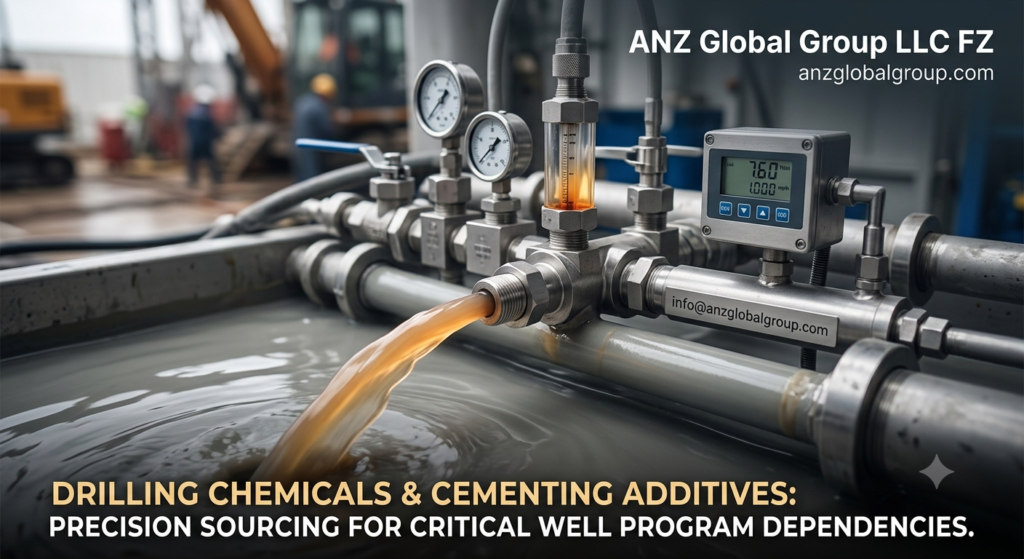
Published by ANZ Global Group LLC FZ | anzglobalgroup.com
Drilling chemicals and cementing additives occupy an unusual position in oil and gas procurement. They are consumed rather than installed, they are highly technical in their application, and they are often procured under time pressure when a well programme is already in motion.
That combination — technical complexity, consumption-based demand, and compressed timelines — makes this one of the categories where procurement decisions have the most direct impact on operational outcomes. The specialty oilfield chemicals market is valued at USD 12.9 billion in 2025 and growing at 3.9% annually, driven by expanding drilling activity and increasingly demanding well environments across deepwater, HPHT, and unconventional plays. The well cement additive segment alone reached USD 1.04 billion in 2025, with more than 8,200 wells drilled globally creating sustained and specific demand.
Getting the right chemicals to the right location, in the right specification, on time, is not a secondary procurement concern. It is a well programme dependency.
Understanding the Product Categories
Drilling chemicals and cementing additives are distinct product categories serving different operational functions, though they are often procured together and sometimes through the same supply channel.
Drilling chemicals are added to drilling fluid systems to control and optimize the drilling process. The specific formulation depends on the formation being drilled, the mud system in use, and the operational objectives of the well programme.
The most commonly procured drilling chemicals include:
- Bentonite — the primary viscosifier in water-based mud systems, used for suspension and filtration control
- Barite — the standard weighting agent, used to increase mud density for wellbore pressure control
- PHPA (Partially Hydrolysed Polyacrylamide) — a shale inhibitor used in water-based systems to stabilise reactive formations
- Polyamine shale inhibitors — stronger inhibition for highly reactive clay formations
- Potassium chloride — ionic shale stabiliser, commonly used in KCl-polymer mud systems
- Calcium chloride — used for completion and workover brines and as a shale inhibitor
- Caustic soda — pH control agent for water-based mud systems
- Glycol — used as a shale inhibitor and lubricant, particularly in directional and horizontal drilling
- EP Lube — extreme pressure lubricant for reducing torque and drag in directional wells
- Haematite — alternative high-density weighting material for applications where barite is unsuitable
- Soda ash — calcium scavenger used in mud treatment
Cementing additives are blended with Portland or engineered cement slurries to ensure wellbore integrity across the full range of downhole conditions — from shallow surface casing to deepwater completions and HPHT environments.
Core cementing additive categories include:
- Silica flour — used in high-temperature wells to prevent strength retrogression of cement above 110°C
- Fluid loss additives — control filtrate loss from the cement slurry into the formation, available in low and high temperature formulations
- Retarders — extend the thickening time of cement slurry for long displacement jobs or high-temperature conditions
- Accelerators — reduce setting time where rapid early strength development is required
- Dispersants — improve slurry rheology and pumpability, reducing equivalent circulating density
- Defoamers — control air entrainment in cement slurries
- Latex — flexible additive improving cement elasticity and resistance to cracking under dynamic loading
- Thixotropic agents — produce gelling properties useful for lost circulation control and inclined wellbore applications
- Sodium silicate — used as an accelerator and for lost circulation treatment
- Expansion additives — compensate for cement shrinkage during hydration, improving annular seal integrity
Why Product Specification Matters More Than Brand
In drilling chemicals procurement, the tendency to specify by brand name — “Baroid” or “M-I” product references — reflects familiarity with service company product lines rather than a technical requirement for that specific branded product.
In international sourcing, brand-equivalent products manufactured to the same chemical specification by certified producers are widely available and frequently used on major projects. What matters is not the brand but the technical specification: the product type, the concentration or grade, the performance standard it must meet, and the compatibility with the mud system or cement slurry it will be used in.
The practical implication: procurement specifications should be written around technical performance parameters, not brand names — particularly when sourcing internationally where brand-equivalent supply from certified manufacturers offers significant cost and logistics advantages.
The Supply Challenges Specific to This Category
Drilling chemicals and cementing additives present sourcing challenges that differ from those associated with tubular products or flanges.
Shelf life and storage conditions. Many drilling chemicals have defined shelf lives and specific storage requirements — temperature ranges, humidity controls, segregation from incompatible materials. These need to be factored into procurement planning, particularly for materials being shipped to remote locations or held in inventory ahead of a well programme.
Batch consistency. Chemical product performance depends on consistent formulation. Batch-to-batch variation in viscosifiers, fluid loss additives, or retarders can produce significant differences in mud system or cement slurry behaviour downhole. Suppliers should be able to provide batch certificates and quality control data confirming consistency across supplied lots.
Destination-specific compliance. Certain chemicals — particularly glycols, biocides, and some dispersants — are subject to environmental and import regulations that vary by destination country. Confirming compliance with the importing country’s chemical regulations before procurement, not after the shipment arrives at port, is part of responsible supply coordination.
Lead time against well schedules. Drilling programmes do not wait. Chemicals that are not on location when the drilling contractor requires them generate operational delays that are disproportionately expensive relative to the value of the chemicals themselves. Procurement planning needs to account for manufacturing lead times, shipping times, and port clearance — particularly for African and remote market destinations.
Documentation for Drilling Chemicals Supply
Unlike OCTG or flanges, drilling chemicals do not come with Mill Test Certificates. The documentation package for chemical products typically includes:
- Product data sheets confirming chemical composition, specifications, and performance parameters
- Safety Data Sheets (SDS/MSDS) — mandatory for transport and handling of chemical products across all international markets
- Certificate of Analysis (CoA) — confirming that the supplied batch meets the stated product specification
- Country of origin documentation — required for customs clearance in most markets
- Dangerous goods classification documentation — where products are classified as hazardous for transport purposes
Incomplete chemical documentation is a consistent cause of customs clearance delays, particularly in African markets with specific chemical import regulations.
ANZ Global Group’s Drilling Chemicals Supply Capability
ANZ Global Group coordinates supply of drilling chemicals and cementing additives for drilling contractors, EPC companies, and operator procurement teams across GCC, Africa, and international markets — sourced from certified manufacturers with batch certification and full documentation support.
Supply categories include the full range of drilling fluid additives and cementing additive products listed above, with documentation, logistics coordination, and delivery follow-up managed as standard elements of the supply engagement.
Email: info@anzglobalgroup.com UAE: +971 50794 4739 India: +91 86799 58783 USA: +1-301-915-0995 Website: www.anzglobalgroup.com
Supplying Trust. Delivering Value.