
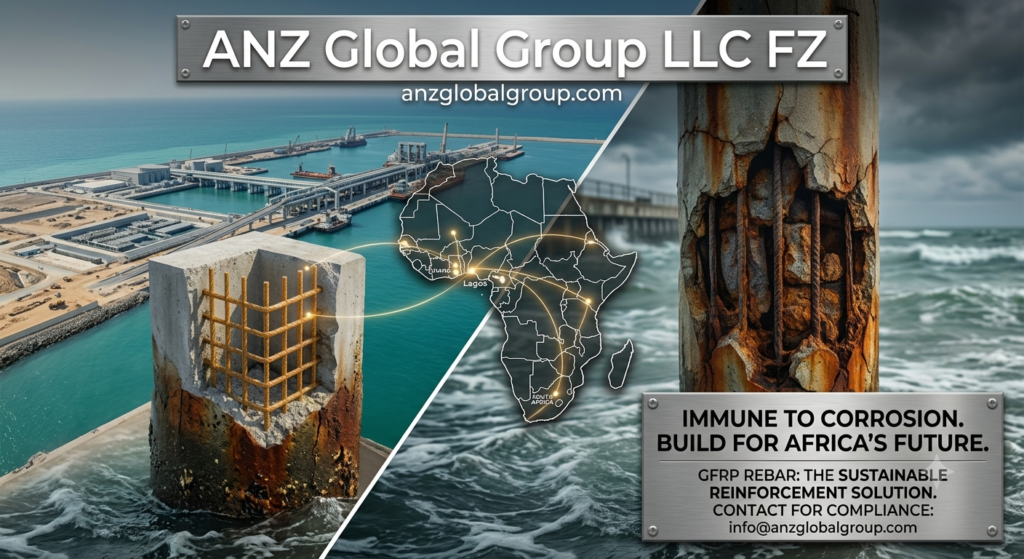
Published by ANZ Global Group LLC FZ | anzglobalgroup.com
Africa is building — and it is building at a pace and scale that is generating sustained demand for construction materials that can perform reliably in the continent’s diverse and often aggressive environments.
The Middle East and Africa region represents 6.2% of the global GFRP rebar market today — a figure that understates the trajectory. Bridges, marine structures, and waterfront developments together accounted for more than 35% of regional GFRP application demand in 2025, driven specifically by corrosion-related maintenance failures in steel-reinforced structures that keep recurring across coastal, port, and water infrastructure. In November 2024, South Africa became home to the continent’s first dedicated GFRP manufacturing facility — GFRP Tech’s Linbro Park plant in Gauteng — a clear signal that African demand for corrosion-free reinforcement is moving from imported product to local production capacity.
The question for developers, contractors, and procurement teams working across Africa is not whether GFRP rebar is relevant to the continent’s infrastructure needs. It is which projects and environments present the strongest case for specifying it now.
Africa’s Infrastructure Environment and the Corrosion Challenge
Africa’s construction environment is not uniform — it spans coastal West Africa, equatorial Central Africa, the arid Sahel, the Horn of Africa, Southern Africa’s industrialised zones, and the North African Mediterranean coast. What most of these environments share, across their diversity, is a set of conditions that are consistently hostile to conventional steel reinforcement.
- Coastal exposure. West Africa’s Gulf of Guinea coastline — from Senegal through to Angola — includes some of the most active port, energy, and urban infrastructure development on the continent, all of it in direct marine exposure. Nigeria’s Lagos, Ghana’s Tema, Côte d’Ivoire’s Abidjan, Cameroon, Gabon, and Angola’s Luanda are coastal cities with active construction pipelines in environments where chloride-induced corrosion attacks steel reinforcement continuously.
- High humidity and tropical conditions. Equatorial and sub-Saharan Africa experience sustained high humidity, high rainfall, and temperature conditions that accelerate concrete carbonation and moisture penetration — increasing the rate at which chlorides and moisture reach embedded steel reinforcement even in structures not directly adjacent to the sea.
- Port and marine infrastructure. Africa’s port infrastructure is being significantly expanded — Lagos, Mombasa, Dar es Salaam, Maputo, Durban, and numerous smaller port facilities are all seeing investment in quay walls, jetties, container handling infrastructure, and associated facilities that sit in permanent marine exposure.
- Water and sanitation infrastructure. Africa faces a significant water and sanitation infrastructure deficit. The continent’s water treatment, distribution, and wastewater management buildout — driven by population growth, urbanisation, and international development financing — is creating demand for structures in exactly the environments where GFRP’s corrosion resistance is most valuable.
- Industrial and energy infrastructure. Mining operations, petrochemical facilities, and power generation infrastructure across Southern and West Africa create aggressive chemical and humidity environments for reinforced concrete structures.
Where GFRP Makes the Strongest Case Across Africa
- Port and coastal infrastructure. Any structure in intertidal, splash zone, or permanent marine exposure on Africa’s coastlines is a strong candidate for GFRP specification. The maintenance cost cycle for steel-reinforced marine structures in West and East African environments is well documented — and the lifecycle cost case for GFRP is straightforward in these applications.
- Bridge and transport infrastructure in coastal and humid zones. Road and rail bridge decks, approach slabs, and coastal highway infrastructure in marine air environments — particularly across Nigeria, Ghana, Kenya, Tanzania, and Mozambique — accumulate corrosion-driven maintenance costs that GFRP eliminates.
- Water and wastewater treatment infrastructure. The African Development Bank and World Bank are among the significant funders of water and sanitation infrastructure across the continent. Structures built today under international development financing need to perform for decades — making lifecycle cost the correct evaluation frame, and GFRP’s maintenance-free service life a directly relevant advantage.
- Industrial foundations and chemical environments. Mining operations across Southern Africa, oil and gas facility infrastructure in West Africa, and chemical processing plants across industrialised zones face concrete structure environments where GFRP’s chemical resistance offers genuine long-term advantage.
- Urban infrastructure in high-growth coastal cities. Lagos, Accra, Abidjan, Nairobi, Dar es Salaam, and Maputo are among the fastest-growing cities in the world, with active construction pipelines for residential, commercial, and infrastructure projects in coastal and high-humidity environments.
The Supply Side: Making GFRP Available in African Markets
One of the practical barriers to GFRP adoption in Africa has been supply chain availability. Steel rebar is locally produced or regionally sourced across most African markets. GFRP has historically required importation from Asia, Europe, or North America — adding lead time, logistics complexity, and import costs that affected price competitiveness.
That supply landscape is changing. South Africa’s first dedicated GFRP manufacturing facility represents a meaningful development — domestic production reduces import dependency and logistics cost for Southern African markets. For other African markets, international sourcing through established supply partners with African market logistics experience remains the primary supply route.
ANZ Global Group’s GFRP supply capability for African markets combines manufacturer partnerships across Asia with the logistics and documentation coordination experience developed through years of O&G supply into African destinations — GCC-sourced material shipped to African ports, with the documentation and customs navigation that African market supply requires.
Standards Applicable to African Markets
GFRP rebar supplied for African infrastructure projects is typically specified against:
- ASTM D7957 / D7959M — the most widely referenced international standard, applicable across African markets where US-influenced engineering specifications are used
- IS 18256:2023 — increasingly referenced on projects with Indian engineering involvement or Indian Development Finance support
- AS 5204:2023 — relevant for projects with Australian engineering input, particularly in Southern Africa
Design references under ACI 440.1R-15 and ACI 440.11-2022 are the primary structural design guides used internationally.
For African public infrastructure projects funded by international development banks, ASTM D7957 compliance with ACI 440 design guidance is typically the accepted specification framework.
Working With ANZ Global Group
ANZ Global Group’s Advanced Reinforcement Solutions vertical sources GFRP rebar for infrastructure developers, contractors, and project teams across Africa and international markets — combining quality-oriented manufacturer sourcing with the logistics and documentation coordination that African market supply requires.
- Email: info@anzglobalgroup.com
- UAE: +971 50794 4739
- India: +91 86799 58783
- USA: +1-301-915-0995
- Website: www.anzglobalgroup.com
Supplying Trust. Delivering Value.