Published by ANZ Global Group LLC FZ | anzglobalgroup.com
There is a moment in almost every problematic supply situation where someone says the same thing: “We should have had inspection in place.”
By that point, the material has already shipped. The non-conformance has already been discovered — at port, at the project site, or worse, during installation. The cost of fixing it is now significantly higher than the cost of preventing it would have been.
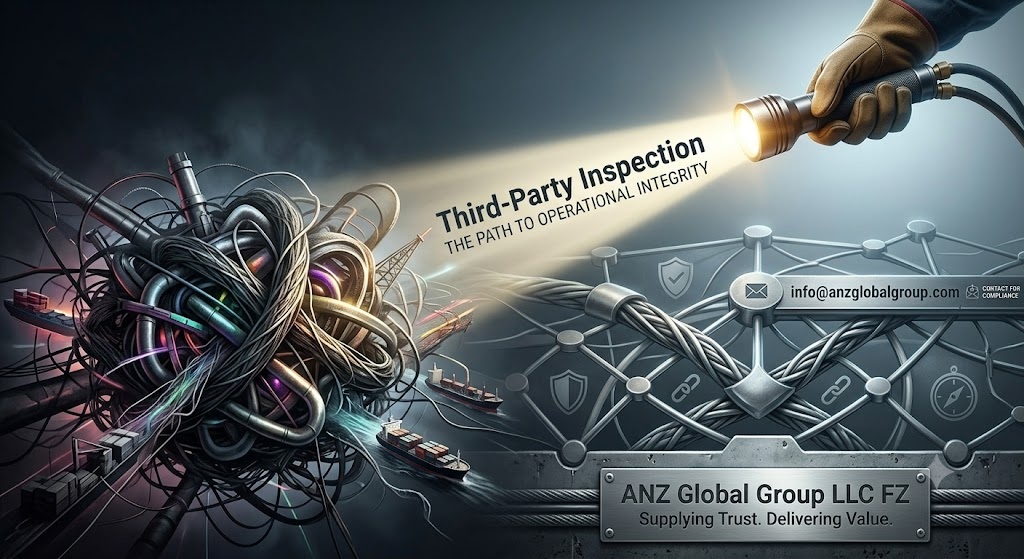
Third-party inspection exists precisely to catch problems before they reach that point. The global TPI market for oil and gas is valued at USD 8.7 billion in 2025 and growing at 5.2% annually — not because inspection is a regulatory formality, but because the industry has learned, repeatedly and expensively, what happens without it. Every dollar spent on preventive inspection yields approximately USD 4.50 in avoided downtime and safety incident costs. That is not a theoretical return. It is the measured outcome of inspection done correctly.
This post covers what TPI actually involves in an O&G supply context, where it adds the most value, and how to coordinate it effectively — including why a sourcing partner who actively promotes TPI, rather than avoiding it, is a fundamentally different kind of partner to work with.
What Third-Party Inspection Actually Covers
TPI in O&G material supply is the independent verification — by an agency that is neither the buyer nor the seller — that supplied materials meet the contractual and technical requirements before they leave the manufacturer.
For OCTG, line pipe, flanges, fittings, and associated materials, a standard inspection scope typically includes:
- Visual inspection — surface condition, end finish, coupling condition, coating integrity, and marking. Physical defects that would not appear on a mill certificate but are visible on the product.
- Dimensional verification — OD, wall thickness, length, drift diameter for tubulars; face-to-face dimensions, bolt circle, and flange thickness for flanges. Confirming that what was produced matches what was ordered.
- MTC review and heat traceability — verifying that the Mill Test Certificates presented correspond to the specific heats and lots in the consignment, and that the recorded values meet the applicable standard. This is where certificate mismatches and traceability gaps are caught.
- Witness testing — for critical grades or demanding applications, the inspector witnesses hydrostatic testing, tensile testing, or other mechanical verification at the mill. This is independent confirmation that test results reflect the actual material, not a representative sample from a different production run.
- Packing and marking inspection — confirming that materials are packed to prevent transit damage, correctly marked with heat and lot identification, and match the packing list before loading.
- Final release — the inspector’s sign-off that the consignment is complete, conforming, and ready to ship. Without this, the material does not move.
Why Most Supply Problems Are Preventable
The pattern in O&G supply failures is consistent enough to be predictable. Materials are sourced. A manufacturer confirms capability and delivery. The order is placed. Inspection is either not arranged, arranged too late, or scoped too narrowly. The consignment ships. The problem surfaces downstream.
71% of major oil and gas operators now mandate third-party validation of supplier capabilities before contract engagement — a figure that reflects how thoroughly the industry has absorbed the cost of getting this wrong. What was once considered an optional additional step is now a baseline expectation on serious projects.
The reason TPI gets skipped is rarely ignorance of its value. It is usually one of three things: cost sensitivity at the front end of a project, time pressure when delivery windows are tight, or a sourcing partner who does not proactively coordinate it because doing so adds complexity to their side of the transaction.
That last point matters more than it might appear.
Why a Trading Company That Promotes TPI Is Different
Most trading companies occupy a straightforward commercial position: source the material, confirm the price, issue the invoice, and ship. Third-party inspection complicates that model. It introduces an independent party who might find something. It adds lead time. It adds cost the supplier sometimes has to absorb or explain.
The rational commercial incentive for a trading company is to avoid TPI, or to treat it as the buyer’s problem to arrange separately.
ANZ Global Group takes the opposite position — deliberately and as a matter of operating philosophy.
ANZ actively coordinates third-party inspection as a standard component of supply engagement, not an optional add-on. The reasoning is straightforward: a client who receives material that fails inspection, causes a project delay, or requires replacement has not been served. The transaction may have completed, but the supply relationship has not. And in the markets ANZ operates in — where project timelines are fixed, drilling schedules do not flex, and the cost of a bad consignment multiplies quickly — a single supply failure damages far more than one order.
Promoting TPI is not a commercial disadvantage for ANZ. It is the mechanism by which client confidence is built and maintained. A buyer who knows that their sourcing partner will coordinate independent verification before shipment — and will stand behind what gets sent — is a buyer who comes back with the next requirement.
That is the commercial logic. The operational logic is simpler: inspection finds problems before they become crises, and preventing a crisis is always cheaper than managing one.
How to Coordinate TPI Effectively
The most common TPI mistake is treating it as a final step rather than a planned component of the supply process. Inspection coordinated as an afterthought — arranged after production is complete, with an agency selected under time pressure — is inspection that has already lost most of its value.
Effective TPI coordination follows a clear sequence:
- Define the scope before the order is placed. What will be inspected, to what standard, with what hold points, and by which agency. This should be agreed between buyer, sourcing partner, and manufacturer at the commercial stage — not negotiated after production has started.
- Select the agency based on client and project requirements. For GCC and African projects, internationally recognised agencies — Bureau Veritas, TÜV SÜD, SGS, and others — are typically required by operators or end-users. The agency should be confirmed, not assumed.
- Establish hold points in the production schedule. A hold point is a defined stage in production or packing where the inspector must sign off before work proceeds. Hold points agreed in advance give the inspector genuine authority — and give the manufacturer clarity on what is expected. Hold points introduced after production is complete give the inspector nothing to hold.
- Allow time in the project schedule for inspection. Inspection takes time. Compressed timelines that leave no room for inspection are timelines that will either skip inspection or be extended when a finding requires resolution.
- Act on findings promptly. TPI findings are not bureaucratic obstacles. They are information — about a non-conformance that needs to be corrected before the material ships, rather than after it arrives. The value of that information is highest when there is still time to act on it.
ANZ Global Group’s Inspection Coordination Approach
ANZ Global Group coordinates third-party inspection through internationally recognised agencies including Bureau Veritas and TÜV SÜD, based on project and client requirements, as a standard element of supply coordination — not a separately negotiated service.
Inspection scope, hold points, and agency selection are confirmed at the order stage. Documentation from the inspection — reports, release certificates, MTC confirmations — forms part of the complete supply documentation package delivered to the client.
For procurement teams who have previously managed inspection arrangements independently, or who have worked with sourcing partners who treated inspection as the buyer’s problem, ANZ’s approach represents a straightforward difference: the inspection is coordinated, the documentation is complete, and the material arrives verified.
That is what execution-focused sourcing looks like in practice.
Working With ANZ Global Group
ANZ Global Group LLC FZ is a Dubai-based industrial sourcing and supply company serving oil and gas, drilling, infrastructure, and advanced materials sectors across GCC, Africa, CIS, and international markets.
- Email: info@anzglobalgroup.com
- UAE: +971 50794 4739
- India: +91 86799 58783
- USA: +1-301-915-0995
- Website: www.anzglobalgroup.com
Supplying Trust. Delivering Value.